
A bathroom material can look perfect under showroom lighting and become a problem six months after installation. Water sits where it should not, grout stains, a glossy floor turns slippery, or a vanity top shows every hard-water mark. When clients ask about the top durable bathroom surfaces, I do not give one answer. A shower floor, a vanity counter, and a feature wall deal with very different kinds of wear.
The right choice comes down to where the material is going, how the bathroom is used, and how much maintenance you actually want to do. In a busy Brooklyn apartment, that may mean choosing porcelain over a beautiful but demanding stone. In a primary bath with proper ventilation and regular care, natural stone may be exactly the point.
Start with the real conditions, not the sample
Before choosing color or pattern, look at moisture, traffic, cleaning habits, and installation details. A material does not perform well simply because it is expensive. It needs the correct substrate, waterproofing, slope, grout, sealant, and transition details around it.
This matters most in showers. Water finds weak points. If the pan is poorly built or the wall system is not waterproofed correctly, the most premium tile in the room cannot save the project. We discuss the full assembly before a client commits to a finish, especially when the plan includes large-format slabs, a curbless shower, or custom niches.
Also consider scale. A pale slab may look quiet in a large primary bath but feel cold in a compact powder room. Small mosaic tile gives a shower floor better traction, yet more grout lines mean more cleaning. These are not reasons to avoid either option. They are reasons to select with open eyes.
Top durable bathroom surfaces by application
Porcelain tile for floors, walls, and showers
For most bathrooms, porcelain is the practical leader. It is dense, highly water-resistant, hard to scratch, and available in finishes that convincingly resemble stone, concrete, wood, and plaster. It can work on floors, shower walls, vanity backsplashes, and, in the right format, shower floors.
The advantage is not just durability. Porcelain gives you control. You can use a large-format tile on the main floor to reduce grout lines, then switch to a smaller coordinating mosaic in the shower for better grip and easier drainage. A matte or honed-look finish is often more forgiving than a polished surface, especially where children, guests, or wet feet are part of daily life.
Not all porcelain is the same, and not every “stone look” tile looks convincing at close range. We recommend seeing full pieces, not just tiny samples. Tile variation, edge quality, and the way the pattern repeats become obvious when you lay out a larger area. New arrivals in the showroom are worth seeing in person for exactly this reason.
The trade-off is installation. Large porcelain panels and oversized tiles require a very flat surface, experienced handling, and careful planning around cuts. They can create a clean, nearly grout-free look, but this is not the place to hire based only on the lowest estimate.
Natural stone when character matters
Marble, limestone, travertine, and slate bring depth that manufactured surfaces rarely duplicate. Each piece has movement, small shifts in tone, and a tactile quality that makes a bathroom feel considered rather than assembled from a catalog. For a client who wants that character, real stone is still a serious option.
But stone has rules. Most natural stone needs sealing, and some varieties are more vulnerable to etching from acidic products, stains from cosmetics, or changes in appearance around constantly wet areas. Honed marble is usually more forgiving than polished marble because etching is less noticeable, but it is not maintenance-free. If you expect it to remain unchanged forever, choose porcelain instead.
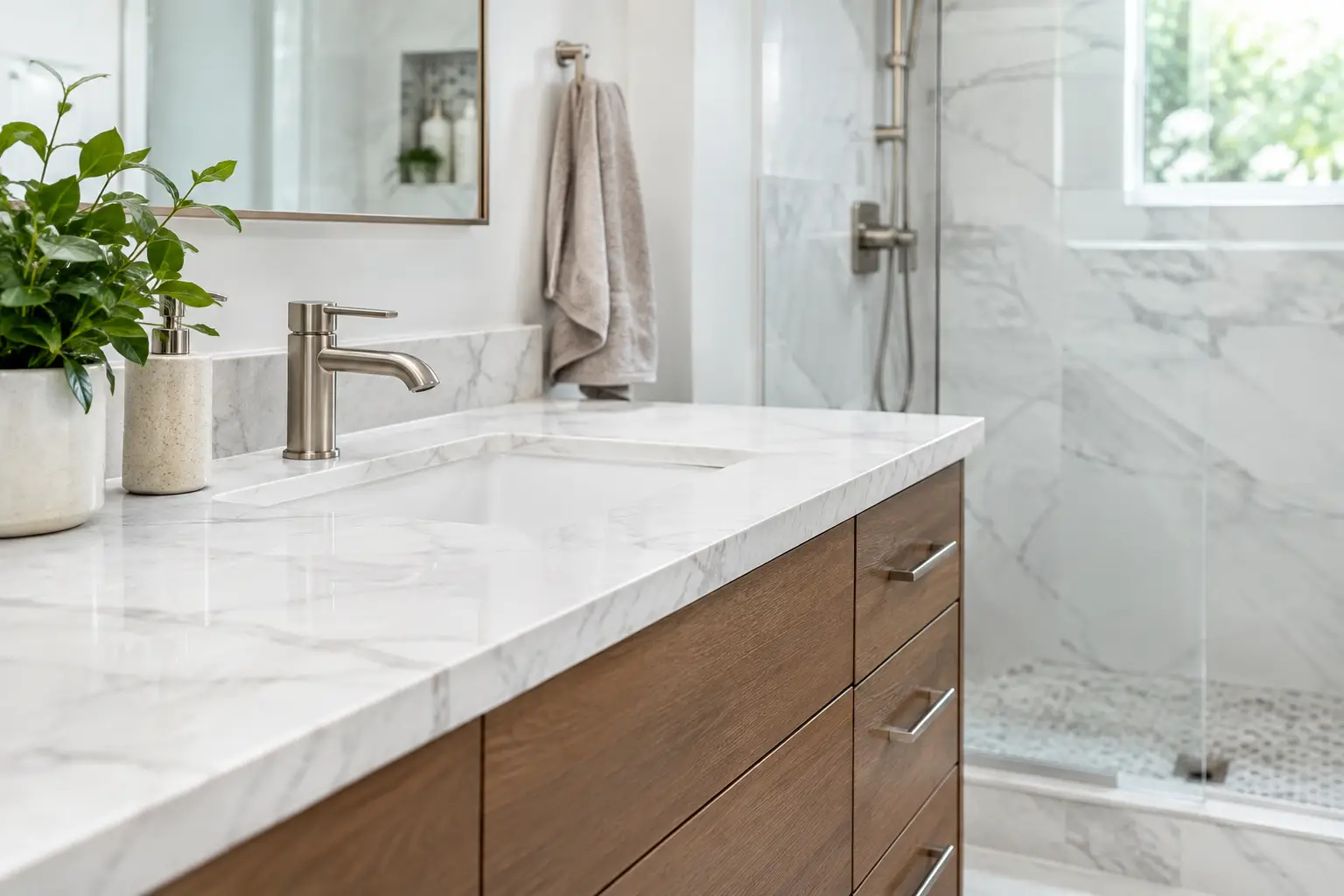
Stone is often best used where its value is visible and manageable: a vanity top, a statement wall, a powder-room floor, or a well-designed primary bath. It can also work in showers, but the stone selection, sealant, ventilation, and cleaning routine need to be appropriate. A beautiful material should not become a source of anxiety every time someone uses the bathroom.
Quartz and sintered stone for vanity tops
The vanity is where clients often want a quiet, continuous surface with minimal maintenance. Quartz is a strong choice for many bathroom counters because it resists stains, does not require regular sealing, and is available in controlled colors and veining. It handles daily toothpaste, makeup, hand soap, and splashes without asking much in return.
There is one caution: quartz is not the material for every high-heat condition, and it should be fabricated and installed properly around sinks and wall connections. In a bathroom, heat is usually less of an issue than in a kitchen, but the quality of fabrication still shows. Sink cutouts, edge profiles, and backsplash joints separate a finished installation from one that looks rushed.
Sintered stone and porcelain slabs are also excellent candidates for vanity tops, shower walls, and integrated bench tops. They are especially appealing when a client wants a very thin profile, a modern stone look, or a surface that can continue from counter to wall without visual interruption. These materials are hard, stable, and low-maintenance, but the slabs require skilled fabricators. The material cost is only part of the budget.
Solid surface for integrated, easy-care design
Solid surface is sometimes overlooked because it does not announce itself like marble. But for a contemporary bath, it can be one of the smartest choices. It creates smooth vanity tops with integrated sinks, clean seams, and a soft matte appearance. It is nonporous and easy to repair if it gets lightly scratched.
This is a very good material for secondary bathrooms, family bathrooms, and projects where a clean, tailored look matters more than dramatic veining. It does not have the natural variation of stone, and it can scratch more easily than porcelain or sintered stone. Still, it offers a calm, practical finish that holds up well when selected honestly for its strengths.
Glass tile, with a careful hand
Glass tile can bring light into a bathroom, particularly on a backsplash, niche, or feature wall. It is nonporous and unaffected by water, but it is not my first recommendation for every large shower installation. It can show installation inconsistencies, and its reflective surface makes lippage or uneven spacing easier to notice.
Use it where it has a job to do. A band of glass mosaic inside a niche, a small accent wall, or a powder-room backsplash can be beautiful. Covering every wall with it is usually more visual activity and more labor than the room needs.
Do not treat grout as an afterthought
Clients often focus on tile and only discuss grout at the end. That is backwards. Grout changes the look, cleaning routine, and long-term performance of tiled surfaces.
A close color match makes a floor or wall feel more continuous and hides minor discoloration. A contrasting grout emphasizes the grid, which can be right for a classic subway tile installation but less forgiving in a high-use bathroom. For many projects, high-performance grout is worth the additional cost. It is more stain-resistant and easier to maintain than basic cement grout, particularly around showers and busy vanity backsplashes.
The grout joint also needs to suit the tile. Rectified porcelain can take a tighter joint, but tight does not mean nonexistent. Bathrooms move slightly, buildings settle, and corners require flexible sealant rather than grout. These are small details until they fail.
The durable choice is not always the hardest material
A surface needs to fit the household. A polished porcelain floor may be technically durable, but a matte finish is more sensible if people walk out of the shower barefoot. White grout may look crisp on installation day, but a warmer gray can make more sense in a family bath. Marble may be right for a client who appreciates patina and wrong for someone who wants every surface to look untouched.
Think about ventilation too. A good exhaust fan, properly sized for the room and used consistently, protects finishes from lingering humidity. It reduces mildew risk at caulk lines, helps painted ceilings last longer, and makes any material choice easier to live with.
Budget for the whole installation
The material price is only one number. Waterproofing, demolition, floor preparation, plumbing changes, tile layout, slab fabrication, and installation can change the total significantly. A less expensive tile with complicated cuts may cost more to install than a premium large-format option with a straightforward layout. The same is true for stone. A simple honed vanity slab may be reasonable; a book-matched wall with custom returns is a different level of work.
When clients come to D&D Design Center, we prefer to review the room as a complete project. Bring dimensions, photos, and a few references if you have them. We can talk through where it makes sense to spend, where a porcelain alternative is smarter, and what needs to be custom-made before the work starts.
The best bathroom surface is the one that still looks right after real mornings, real showers, and real cleaning. Choose it for the room you have, not for a photograph, and make sure the installation is built to support it.