
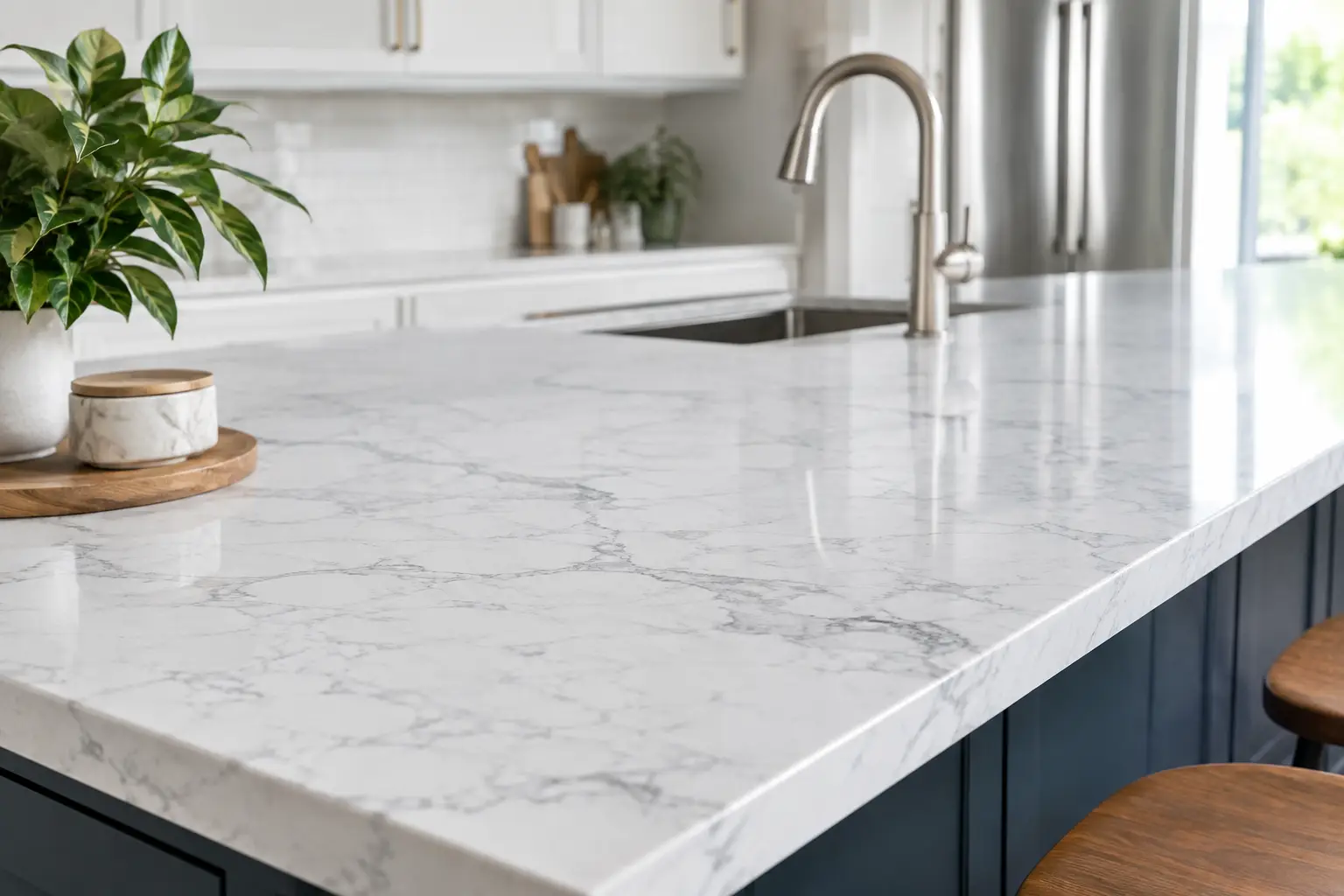
A white quartz sample can look perfect under showroom lighting. The real question is what it will look like after Sunday breakfast, a hot pan placed down too quickly, tomato sauce near the edge, and years of use around the sink. This quartz countertop material review is for homeowners who want a clear answer before choosing a slab: quartz is an excellent material for many kitchens, but it is not the right answer for every client or every design.
What Quartz Actually Is
Quartz countertops are engineered stone. They are made from natural quartz particles mixed with resin, pigments, and binders, then pressed into slabs. That manufacturing process is the reason quartz has such consistent color, a smooth finish, and a surface that does not need routine sealing.
Clients often walk in asking for "white marble." Once we discuss maintenance, many mean they want the bright background and soft movement of marble without worrying about every splash of lemon juice or red wine. Quartz can be a smart alternative, especially in a busy family kitchen, but the look needs to be chosen carefully. Some marble-look quartz is convincing from a distance and less convincing when you stand at the island every morning.
This is why we do not select a countertop from a small sample alone. We look at the full slab, the cabinet color, the flooring, the backsplash, and the lighting in the actual space. A material that looks warm in a showroom can read cold or gray in a Brooklyn apartment with limited natural light.
Quartz Countertop Material Review: The Real Advantages
The strongest argument for quartz is everyday maintenance. It is nonporous, so normal kitchen spills do not soak into the surface the way they can with some natural stones. You do not need to schedule annual sealing. For clients who cook often, have children, or simply do not want another maintenance task, that matters.
Quartz is also highly resistant to staining when used normally. Coffee, oil, berries, and wine are less stressful on quartz than on many porous natural materials. Clean it with a soft cloth, mild soap, and water, and do not turn a simple countertop into a chemistry experiment with aggressive cleaners.
The design range is another major advantage. There are clean solid colors, concrete-inspired finishes, soft limestone looks, dramatic veining, and warm off-whites that work well with wood cabinetry. If the kitchen calls for a very controlled palette, quartz gives a level of consistency that natural marble and granite cannot always provide.
That consistency is particularly useful in a custom kitchen with long runs of cabinetry. When we are coordinating a large island, perimeter counters, waterfall panels, and a backsplash, predictable patterning can make layout decisions easier. It can also help keep the room calm when the cabinetry already has detail, texture, or a strong wood grain.
Where Quartz Has Limits
Quartz is durable, but durable does not mean indestructible. The resin inside the slab can be damaged by excessive heat. A hot pot or sheet pan should not go directly onto quartz. Use a trivet. This is one of the first conversations worth having because a person who routinely places cookware straight from the oven onto the counter may be better served by a different material.
Strong direct sunlight can also be a consideration. In areas with intense sun exposure, especially near large windows or in an outdoor kitchen, some quartz products may discolor or fade over time. Product specifications differ, so the exact slab and location need to be reviewed before ordering. Indoor use is generally straightforward. Exterior use is a separate discussion.
Seams are another point where clients need honest expectations. Large islands and L-shaped kitchens often require seams because slabs have physical size limits. A good fabricator places and finishes seams carefully, but they do not disappear completely. Veined quartz requires even more planning because the pattern has to be aligned thoughtfully. If someone promises an invisible seam in every situation, slow the conversation down.
Quartz can chip at exposed edges if it receives a hard impact. This is most likely near a sink cutout, a sharp corner, or a raised bar edge. Rounded profiles and careful fabrication reduce the risk. Again, this is not a reason to avoid quartz. It is simply part of choosing a material based on how the kitchen will be used.
The Look Matters as Much as the Performance
The best quartz choice is not always the brightest white or the slab with the biggest veins. A kitchen can look expensive in a restrained way when the undertones are right. Warm white cabinetry often needs a countertop with cream, sand, or soft taupe in it. Cool white quartz next to warm cabinets can make the whole room feel disconnected.
For a contemporary kitchen, a low-movement quartz in a warm white, charcoal, or soft gray can give the cabinetry room to speak. For a more classic layout, a quiet marble-look quartz can bring lightness without making the kitchen feel overly formal. If the goal is an Italian kitchen with textured cabinetry, fluted glass, or metal details, we usually look for a countertop that supports those materials instead of competing with them.
Be cautious with highly dramatic imitation marble if the slab does not have depth. A bold vein can look impressive on a sample and repetitive across a large island. This is where full-slab viewing is worth the time. You want to see the scale of the veining, where the fabrication cuts will fall, and whether the pattern looks natural across the entire composition.
Budget Is More Than the Slab Price
When comparing quartz quotes, do not look only at the square-foot number. The final cost depends on slab size, thickness, edge profile, cutouts, backsplash height, waterfall panels, delivery conditions, and installation complexity. A simple straight run is one project. A large island with mitered edges, an undermount sink, multiple outlets, and a full-height backsplash is another.
In New York City, site conditions can also affect the plan. Elevator access, stairs, building protection requirements, and tight entryways are not minor details when a heavy slab is being brought into an apartment. These items should be discussed before the material is ordered, not when the installers are standing downstairs.
A good countertop plan starts after cabinets are finalized or at least measured accurately. Cabinet dimensions, appliance specifications, sink selection, and wall conditions all affect the fabrication template. If a renovation is moving quickly, it is tempting to order early. But changing an appliance or shifting an island after a countertop has been fabricated is an expensive way to lose time.
Questions to Ask Before Choosing Quartz
Ask to see the actual slab, not only a sample. Ask whether the selected color is available now and whether additional slabs from the same lot can be reserved if your project requires them. Ask where seams will be placed and how the veining will be handled around corners, waterfalls, and backsplashes.
You should also ask about the warranty, fabricator experience, edge options, and the care requirements for that specific product. Not every quartz brand has the same finish, thickness, heat guidance, or availability. If you are matching a countertop to custom cabinetry, bring a door sample and any backsplash tile to the meeting. Looking at materials together prevents expensive surprises.
For homeowners choosing between quartz, marble, porcelain, or granite, the right decision usually comes down to priorities. If you want low maintenance and dependable daily performance, quartz is hard to beat. If you want the depth and natural variation that only real stone develops, marble or quartzite may be worth the extra care. If heat resistance is at the top of the list, porcelain deserves a serious look.
At D&D Design Center, we prefer to have that conversation in front of real materials, not through a few photos on a phone. Bring the cabinet finish, a floor sample, or even a rough drawing of the room. We can look at the proportions, discuss what will hold up in your home, and help you avoid choosing a slab that only looked good for five minutes in a showroom.