
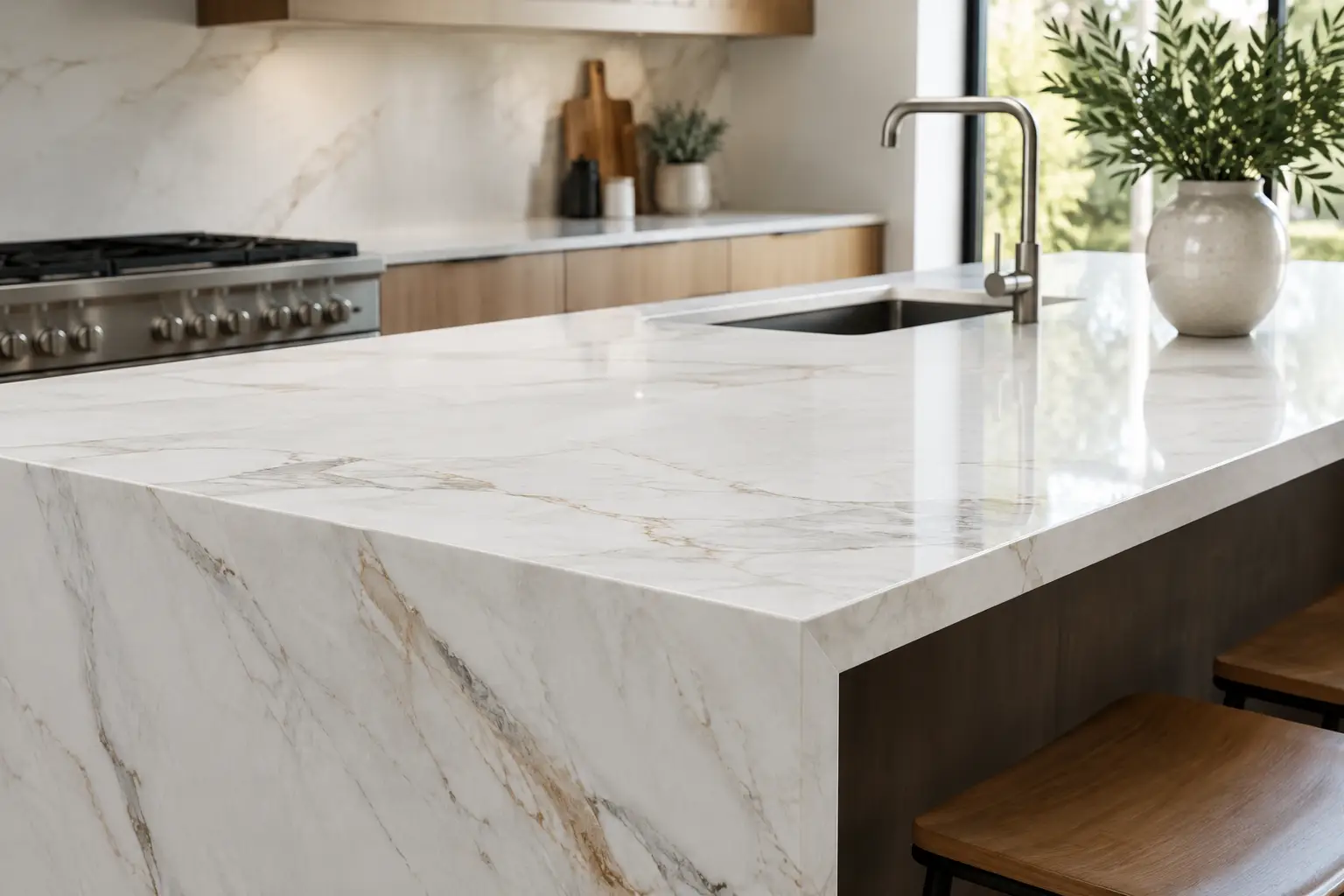
A porcelain slab countertop review should start with the part many people miss in a showroom: porcelain can look exceptionally refined, but the success of the finished kitchen depends as much on fabrication and installation as it does on the slab itself. We see clients come in with a saved image of a dramatic marble-look island, then ask the right question: will it still look good after real dinners, hot pans, kids, cleaning, and daily use? In many homes, porcelain is a very strong answer. It is not automatically the right answer for every detail.
Porcelain slabs are made from natural minerals and fired at extremely high temperatures. The result is a thin, dense surface with a convincing range of stone, concrete, metal, and solid-color finishes. It is especially appealing for clients who want the movement of Calacatta marble without accepting the staining and etching that come with real marble.
Porcelain Slab Countertop Review: Where It Performs Best
The strongest argument for porcelain is practical. It is nonporous, so red wine, lemon, oil, coffee, and tomato sauce do not soak into the surface the way they can with natural stone. There is no routine sealing schedule to remember. For a busy family kitchen or an apartment where the kitchen gets used hard, that is a real benefit, not a brochure feature.
Heat resistance is another reason porcelain gets attention. A hot pan is far less likely to damage porcelain than it is to leave a mark on many engineered surfaces. Still, I would not tell a client to make a habit of dropping a scorching cast-iron skillet onto any finished countertop. The surface may tolerate heat, but sudden temperature changes, stress at a cutout, and a heavy impact are different issues.
Porcelain also holds color well in bright rooms. If your kitchen has large windows, skylights, or direct sun, the material is generally a safer choice than surfaces that can yellow or change over time. That makes it useful beyond the kitchen too, including fireplace surrounds, wall cladding, bathroom vanities, and certain outdoor applications when the specific slab and installation system are appropriate.
Visually, the material has come a long way. Better Italian slabs now offer depth, veining, and matte textures that do not read as flat from across the room. Some clients want a quiet warm-white surface. Others want a bold bookmatched island that becomes the center of the kitchen. The slab selection matters because two porcelain designs with the same general color can look completely different once the light hits them in a Brooklyn brownstone or a high-rise apartment.
The Trade-Offs You Should Know Before Ordering
Porcelain is hard, but it is not indestructible. The field of the countertop is highly scratch- and stain-resistant. Its vulnerable areas are the edges, corners, and cutouts around a sink or cooktop. A dropped heavy pot can chip an exposed edge. That is why edge design is not a small decision.
A thick-looking mitered edge can give porcelain the visual weight of a substantial stone slab, but it requires excellent fabrication. Poorly matched miters, visible glue lines, or careless handling at the corners will cheapen an otherwise beautiful material. A simple eased edge can be a smart choice when the design is minimal and the client wants fewer vulnerable details.
The thin profile is also a matter of taste. Most porcelain countertop slabs are much thinner than a typical granite or quartz slab. That can look crisp and architectural, especially with modern cabinetry. But if you want a deeply rounded traditional edge or a countertop that feels visually massive, natural stone may give you more flexibility.
Pattern continuity deserves an honest conversation as well. Porcelain can offer dramatic veining, but the printed or manufactured pattern may not continue through the edge the way it does in a full-body natural stone. A skilled fabricator can manage the visual transitions well, but the material has its own character. Do not choose it expecting it to behave exactly like quarried marble.
Installation Is the Part That Cannot Be Improvised
A porcelain slab project needs a team that understands the material. The slabs are large but relatively thin, and they must be transported, cut, supported, and installed carefully. This is not the place to save a small amount by handing the job to a fabricator who treats every surface the same way.
Measurements should happen after cabinets are installed and leveled. If the cabinetry is not properly set, a thin slab can reveal every problem. Large islands, extended overhangs, and waterfall panels may require added support or a specific substrate. Sink and cooktop cutouts should be planned early, including the faucet position, reveal, and the exact sink model.
Seams are possible, even on large slabs. Their location depends on the layout, slab size, access to the apartment or house, and how the fabricator plans the cuts. A good seam is discreet. It should be discussed before fabrication, not discovered on installation day.
For clients planning a full renovation, this is why a coordinated kitchen project is easier than buying a slab in isolation. Cabinet dimensions, appliance specifications, backsplash thickness, lighting, and countertop details affect one another. At D&D Design Center, those are the conversations we want to have before the order is finalized, while there is still time to make the details work.
Details That Affect the Finished Look
A porcelain countertop can look expensive or merely expensive on paper. The difference often comes down to a few decisions: whether the backsplash is the same slab or a separate material, how the island edge is built, whether the waterfall vein is aligned, and where the seams fall.
A full-height porcelain backsplash creates a clean, continuous look and removes grout lines behind the range. It also adds material and fabrication cost. If budget needs to stay controlled, a porcelain counter with a well-chosen tile backsplash can still look finished and intentional.
For an undermount sink, porcelain works well, but the edge polish and reveal must be clean. For a farmhouse sink or a large workstation sink, support becomes more important. These are small points when viewed on a sample, but they matter every morning when the kitchen is in use.
What Does a Porcelain Slab Countertop Cost?
Porcelain is usually positioned as a premium countertop material. In New York City and Brooklyn, installed pricing can land near high-end quartz or natural stone, and sometimes above it. The final number is not just the slab price. Fabrication complexity, mitered edges, cutouts, full-height backsplashes, waterfall panels, delivery access, and installation conditions all affect the budget.
A straightforward perimeter countertop with standard cutouts is one project. A bookmatched island with two waterfall legs, a full-height range wall, and a difficult apartment delivery is another. Comparing only price per square foot will not give you a useful answer.
Ask for a scope that makes the details clear: selected slab, thickness, edge treatment, seam plan, sink and cooktop cutouts, backsplash pieces, delivery, installation, and any required support. If something is not specified, it is difficult to compare proposals fairly.
Who Should Choose Porcelain, and Who Should Not?
Choose porcelain if you want a low-maintenance surface with strong heat, stain, and UV performance, and you like a clean contemporary profile. It is especially good for a client who loves the look of marble but does not want to worry about every glass of wine or splash of lemon juice.
Think twice if you want heavily shaped edges, a soft aged patina, or the unique depth and through-body veining of a natural stone. Quartz may be the simpler choice for certain standard kitchen layouts. Honed granite may make more sense for someone who wants a thicker, more traditional material with less concern about exposed corners. Real marble remains beautiful, but it asks for acceptance of its natural changes over time.
The right countertop is not the one with the strongest sales pitch. Bring a cabinet door, a floor sample, and a few photos of your space into the showroom. We can put materials together under real light, talk through the fabrication details, and tell you where porcelain makes sense before you commit to a slab.