
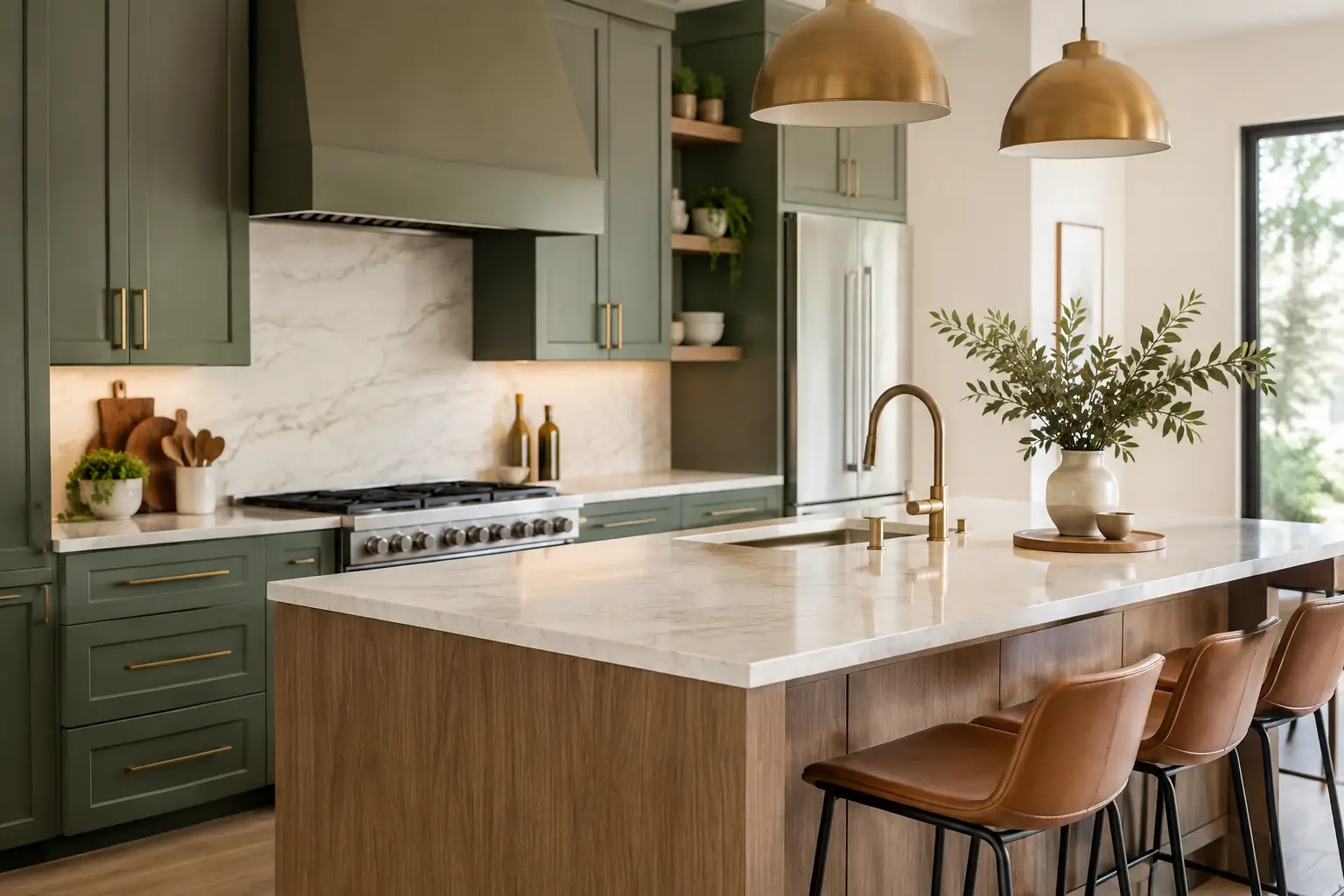
Walk into a kitchen showroom right now and the shift is obvious. The new kitchen finish trends are not about making every surface shout. Clients are asking for warmth, depth, and materials that still look good after years of breakfasts, dinner parties, and real family life. That means fewer cold gray kitchens, less high-gloss for the sake of shine, and more attention to how wood, stone, metal, and cabinetry sit together in one room.
A finish is not a small decision made at the end of a project. It affects how a kitchen feels at 8 a.m., how it photographs in afternoon light, how often you see fingerprints, and whether the room will feel dated in three years. When clients come into our Brooklyn showroom, we put samples next to each other and look at them under real light. That is where a finish either makes sense or does not.
New Kitchen Finish Trends Are Getting Warmer
The strongest movement is toward warmer, more natural tones. Not orange wood, not the heavy Tuscan kitchen from twenty years ago. Think smoked oak, warm walnut, muted elm, and matte lacquer colors with a little earth in them: mushroom, soft taupe, clay, olive gray, and deep tobacco.
For a long time, cool white and gray dominated kitchen remodeling. They were safe choices, especially in New York apartments where clients wanted the space to feel bright. But an all-white kitchen can feel flat if there is no material contrast. A warm wood island, a textured stone backsplash, or bronze hardware gives the room a center of gravity.
This does not mean every kitchen has to be brown. In a smaller Brooklyn kitchen with limited daylight, pale cabinetry can still be the right choice. The difference is in the undertone. Instead of a sharp blue-white finish, we may use a warmer off-white with natural oak, brushed nickel, and a stone countertop that has movement. The room stays light without looking clinical.
Wood is being used with more restraint
Wood cabinetry is back, but the best projects use it carefully. A full kitchen in dark walnut can be beautiful in a large home with good light and high ceilings. In a typical apartment, it may be too much. Often, the better solution is wood on the island or lower cabinets, paired with a quieter upper cabinet finish.
Rift-cut and vertical grain patterns are especially popular because they feel clean without looking artificial. The grain becomes part of the design, but it does not compete with the rest of the room. With Italian kitchen cabinets, the quality of the veneer, edge detail, and door construction matters just as much as the color. A sample can look excellent in your hand but disappoint on a full wall if the grain matching and fabrication are not handled properly.
Matte Is Still Strong, but Texture Matters More
Matte finishes are not going away. They hide minor marks better than high gloss, reduce glare, and bring a more architectural look to the kitchen. But plain matte is no longer enough by itself. Clients want a finish that has character when they stand close to it.
We are seeing more brushed lacquers, lightly textured laminates, wire-brushed woods, fluted glass, honed stone, and metal details with a living surface. These materials give a kitchen depth without adding unnecessary decoration. You notice the difference when the light moves across them.
There is a practical side to this trend. A perfectly smooth dark cabinet can show every fingerprint, especially around the refrigerator and pull-out pantry. A textured matte surface is often more forgiving. That said, texture should be selected with cleaning in mind. Deep grooves behind a cooktop or on a heavily used cabinet door can collect grease and dust. We discuss where the material will go before choosing it, not after it is already ordered.
Honed stone over polished perfection
For countertops and backsplashes, many clients are choosing honed or leathered surfaces instead of a mirror-polished slab. Honed marble, quartzite, porcelain, and certain engineered surfaces can look softer and more natural, especially beside warm cabinetry.
The trade-off is simple: some natural stones require more care. A honed marble countertop can develop a patina. For one client, that is part of the appeal. For another client who cooks often with lemon, wine, and tomato sauce, it can become an irritation. There is no universal answer. We look at how the kitchen will actually be used and select the material accordingly.
Quiet Contrast Replaces the Two-Tone Gimmick
Two-tone kitchens are still relevant, but the contrast is more controlled now. Instead of bright white uppers with nearly black lowers, clients are choosing colors and materials that are closer together: taupe with oak, soft gray with walnut, cream lacquer with a warm charcoal island.
This approach creates separation without making the kitchen feel chopped into pieces. It also gives a custom kitchen a calmer, more expensive appearance. Strong contrast can work in the right loft or contemporary home, but it has to be supported by the architecture. If everything else in the apartment is quiet, a dramatic black-and-white kitchen can feel like it belongs to another property.
A darker island remains a good option, particularly when it is treated like furniture. Use a richer wood or deeper lacquer, then give it a stone top with an overhang that is comfortable for seating. The island becomes a focal point without forcing the perimeter cabinets to do too much.
Metal Finishes Are Becoming More Personal
Polished chrome will always have a place, but brushed nickel, warm brass, bronze, and darkened metal are receiving more attention. The most successful kitchens are not matching every metal exactly. They are coordinating them.
For example, a brushed nickel faucet can work with bronze cabinet pulls if the surrounding finishes are warm and intentional. What usually does not work is adding three unrelated metal colors because each item was chosen separately. Hardware, faucet, lighting, appliance handles, and even the profile of a glass cabinet frame need to be reviewed as one composition.
Living finishes deserve an honest conversation. Unlacquered brass and some bronzes change over time. They may darken, develop spots, or show more character in high-touch areas. Some clients love that. Others expect the finish to stay exactly as it looked on installation day. If you want consistency, a protected finish may be the smarter choice.
The Best Finish Is Built Around the Room
Trend reports can point you in a direction, but they cannot measure your kitchen. Before deciding on cabinetry colors or stone, we look at ceiling height, window exposure, adjoining floors, appliance placement, and the amount of storage the household needs. A beautiful finish can fail if it makes a narrow galley kitchen feel tighter or if the countertop edge conflicts with the cabinet profile.
This is also why samples should be viewed in the actual space whenever possible. Brooklyn light changes dramatically from one side of a building to the other. A warm gray that looks elegant in the showroom may look green in a north-facing apartment. A stone slab that seems subtle under display lighting may have much stronger veining in direct sun.
Budget and lead time matter too. Some finishes are readily available. Others involve custom stain matching, special-order slabs, or cabinetry from Italian suppliers with a longer production schedule. There is nothing wrong with waiting for the right material, but the timeline should be clear before demolition begins. A well-planned kitchen is not only about what you see at the end. It is about avoiding expensive changes halfway through.
How to Choose Without Chasing Every Trend
Start with the finish you want to live with most closely. For some clients, that is the cabinet door. For others, it is the countertop because they cook every day and want a surface they enjoy touching. Then build the remaining materials around that choice.
Keep the permanent elements quieter than the pieces you can replace later. Cabinetry, countertops, flooring, and backsplash should have staying power. Hardware, stools, pendants, and accessories can carry a little more personality because they are easier to update. This is how a kitchen can feel current without becoming a trend display.
Bring photos, measurements, floor plans, and even a sample of your existing flooring to the showroom. We can put materials together, discuss custom sizes and storage, and tell you where it makes sense to spend more. The right kitchen finish is not the one everyone is posting this year. It is the one that still feels right when you walk into your own home every morning.