
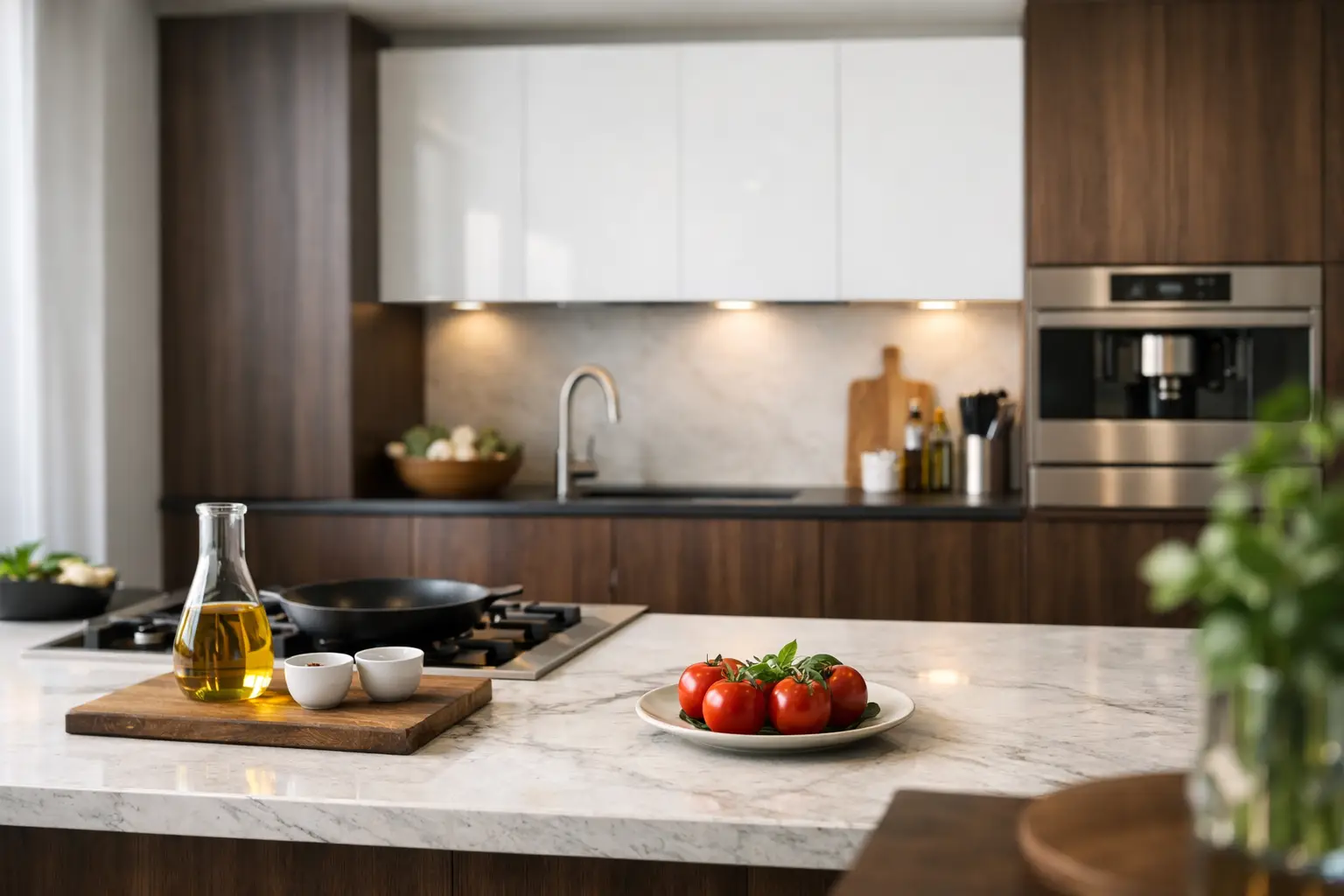
A good Italian kitchen does not announce itself with a glossy brochure. You notice it when a tall pantry closes without a rattle, when the cabinet finish still looks clean near the cooktop, and when the drawers hold heavy cookware without falling out of alignment. That is the standard behind this Italian kitchen cabinet review: not whether the kitchen photographs well on day one, but whether it makes sense in a real home after years of breakfasts, dinners, guests, and daily use.
Italian cabinetry can be exceptional, but the label alone is not a quality guarantee. There are different construction levels, finish systems, suppliers, lead times, and installation standards. A serious review has to look past the word Italian and ask what is actually being specified for your space.
What Makes Italian Kitchen Cabinets Different?
The strongest Italian kitchen manufacturers treat the kitchen as a coordinated architectural system. Cabinet fronts, carcasses, interior fittings, tall units, panels, lighting details, and appliances are planned together. That creates a cleaner result than assembling unrelated boxes, fillers, and hardware on site.
The design language is usually disciplined. You see fewer unnecessary details and better proportion between cabinets, countertop, island, and wall space. A handleless door may look simple, for example, but it depends on precise reveals, reliable opening mechanisms, and careful installation. If one line is off, the whole kitchen looks off.
Materials are another reason clients consider Italian cabinetry. Depending on the collection, that may mean lacquered MDF, veneered panels, textured melamine, glass, aluminum framing, stone-look surfaces, or real wood details. The better lines use consistent materials and controlled manufacturing, which matters when every door and panel must match under the same lighting.
That said, Italian does not automatically mean solid wood, and solid wood is not automatically the best choice. A stable engineered panel with a high-quality lacquer or veneer can perform better in a New York apartment kitchen than a poorly managed solid-wood door exposed to steam and changing temperatures. The right material depends on the look, budget, and how the kitchen will be used.
Italian Kitchen Cabinet Review: What We Look At First
When clients come into the showroom, we do not start by choosing a door color. We start with the room. Brooklyn brownstones, condos, and older co-ops often have uneven walls, limited access, radiator locations, structural columns, and plumbing that cannot simply move wherever the drawing says it should.
A cabinet system needs to respond to those conditions. The first question is whether the manufacturer offers enough sizes, depths, and customization to make the design look intentional. A kitchen can be technically filled with cabinets and still look like it was forced into the room. The difference is often in the end panels, filler strategy, tall-unit proportions, and how the cabinetry meets the ceiling.
We also look closely at the cabinet box construction. Ask what the carcass is made from, how the edges are finished, and whether the material is appropriate for a sink base or dishwasher area. Moisture resistance matters, but so does proper installation. Even excellent cabinetry will suffer if a leaking dishwasher is ignored for months.
Hardware is not a minor detail. Open every drawer. Check the pullout pantry, corner solution, trash unit, and lift-up doors if the design includes them. Quality runners should operate quietly under weight and allow adjustment after installation. The hardware should be serviceable, not a mystery part that becomes difficult to replace five years later.
Finish quality deserves a close look under normal light, not only showroom spotlights. Matte lacquer can be beautiful and soft to the touch, but some dark matte finishes show fingerprints more easily than textured surfaces. High-gloss lacquer reflects light and can make a compact kitchen feel larger, though it may show smudges and scratches more readily. Wood veneer brings warmth, but it should be selected with realistic expectations about grain variation. There is no universal best finish. There is only the finish that fits your household.
The Layout Matters More Than the Cabinet Style
A beautiful kitchen with a weak layout becomes frustrating quickly. Before choosing between oak veneer and warm gray lacquer, decide how the kitchen needs to work every morning and every night.
Think about where groceries enter, where they land, where dry goods go, and how far you carry a heavy pot from the cooktop to the sink. In a family kitchen, a large refrigerator and a serious pantry may matter more than an oversized decorative island. For an apartment owner who entertains, hidden appliances, a wine column, and uninterrupted countertop space may be the priority.
Italian systems are particularly strong when the layout needs a composed, furniture-like look. Tall units can conceal refrigeration, ovens, storage, and even a small work zone. Lower cabinets can be designed with deep drawers instead of hard-to-reach shelves. This is not just visual. Deep drawers make everyday cookware easier to organize and easier to see.
But do not let minimalism create inconvenience. A completely handleless kitchen can look excellent, yet some clients prefer a discreet pull or integrated handle near heavily used areas. If you cook often, test it. Open the refrigerator surround, the dishwasher panel, and the waste drawer with one hand. The kitchen should feel good in motion, not only in a rendering.
Budget, Lead Time, and the Parts People Forget
The cabinet price is only one part of the project. A proper number also accounts for design work, field measurements, delivery, building requirements, installation, countertop templating, appliances, plumbing, electrical changes, backsplash, and finishing work. In New York City, elevator reservations, certificate-of-insurance requirements, and restricted work hours can affect both timing and cost.
Italian cabinetry often requires a longer planning window than stock cabinets because the kitchen is ordered for the project. That is a strength when you want specific dimensions and finishes, but it means decisions must be made early. Appliance specifications cannot be vague. A change from one refrigerator model to another can affect cabinet dimensions, ventilation, panels, and electrical placement.
Be direct about the budget from the beginning. There is no benefit in designing a large wall of specialty storage if the project allowance supports a simpler solution. A good designer can protect the look by putting the money where it shows and performs: the main cabinetry, the island, visible end panels, useful hardware, and a countertop that fits the room. Less visible areas can sometimes be simplified without hurting the final result.
Installation Is Where a Good Kitchen Can Go Wrong
Fine cabinetry is not forgiving of careless installation. Floors are rarely level, walls are rarely straight, and old buildings rarely cooperate. The installer needs to establish level lines, correct for site conditions, align doors and drawer fronts, and maintain consistent gaps across the full run of cabinets.
This is especially important with contemporary Italian kitchens. Flat fronts and handleless channels create long horizontal and vertical lines. They expose mistakes immediately. The cabinet plan must also coordinate with the countertop fabricator, electrician, plumber, appliance team, and any contractor handling walls or flooring.
Before ordering, make sure the team has confirmed the final field measurements and appliance cut sheets. Before installation, make sure flooring, wall conditions, and utilities are ready. After installation, inspect every drawer, door, panel, and appliance clearance before the project is considered complete. Warranties on materials and workmanship are meaningful only when there is a real team available to address an issue.
Who Should Choose Italian Cabinetry?
Italian kitchen cabinets are a strong fit for homeowners who want a composed, custom-looking kitchen and are willing to plan it carefully. They work especially well when the kitchen is central to the home, when aesthetics matter beyond the resale listing, and when storage needs to be built around real routines.
They may not be the best choice for a rushed project with an immovable deadline, a temporary renovation, or a budget that leaves no room for proper installation and countertops. In those cases, a more straightforward cabinet solution may be the smarter decision. Quality is not about buying the most expensive option. It is about choosing a system that fits the room and supporting it with the right planning.
At D&D Design Center, the useful conversation begins when you bring in the plan, measurements, appliance ideas, and a realistic sense of how you live. If you are considering Italian cabinetry, come see the materials in person, open the drawers, compare finishes in real light, and ask the questions that are hard to answer from a screen. A kitchen is too permanent, and too expensive, to choose based on a perfect photo alone.