
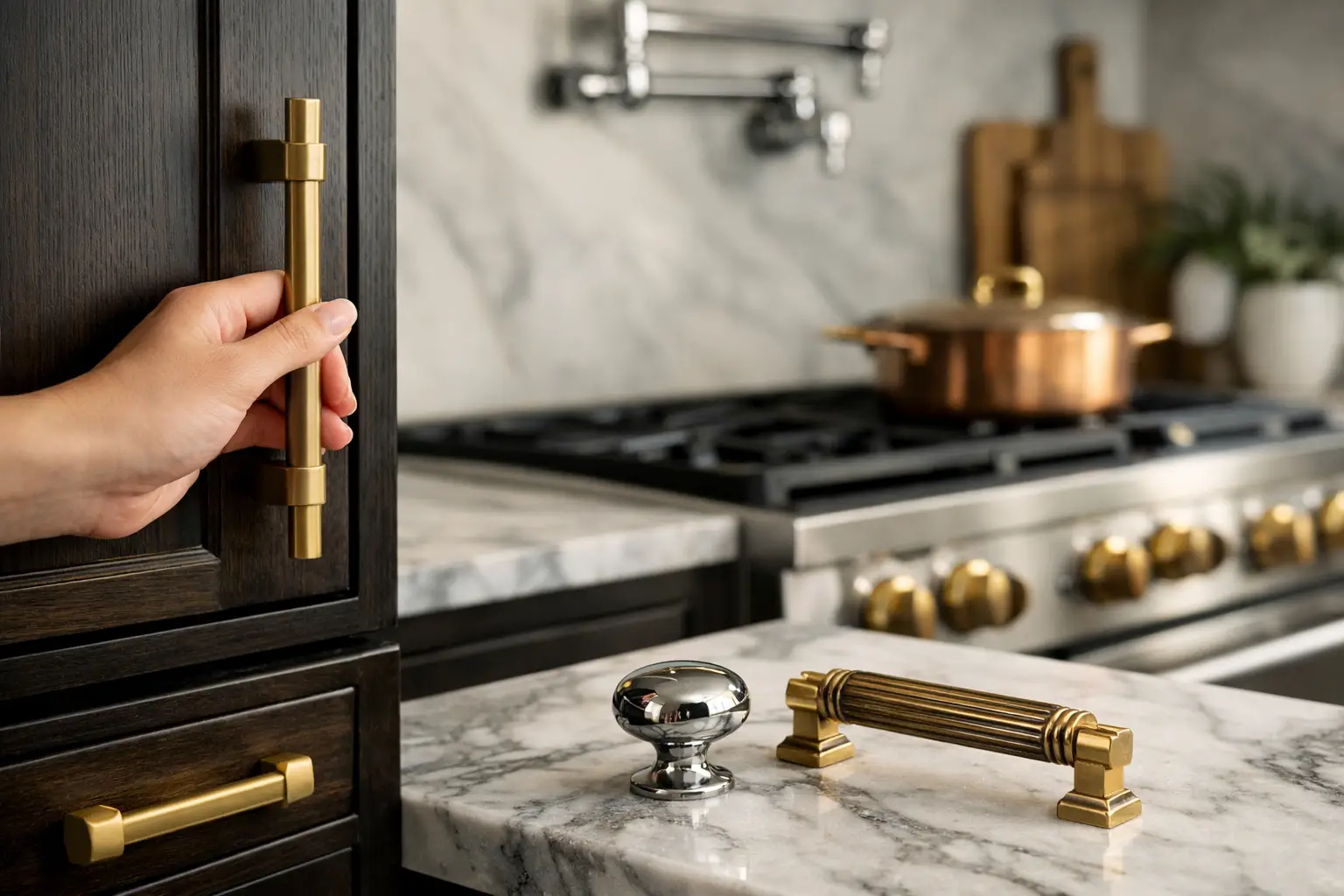
A beautiful kitchen can be weakened by the smallest detail. You can have custom cabinetry, stone countertops, and excellent lighting, then install lightweight pulls that feel hollow in the hand. Clients ask us how to choose luxury kitchen hardware because they understand this instinctively: the handles, knobs, hinges, and interior fittings are what they touch every day.
Hardware is not an afterthought. It affects how a kitchen feels at 7 a.m., how cabinet doors close after dinner, and whether the room still looks considered years after installation. The right choice is not always the most expensive piece in the showroom. It is the piece that fits the cabinet design, the finish palette, the scale of the room, and the way your household actually uses the kitchen.
How to Choose Luxury Kitchen Hardware for Your Kitchen
Start with the cabinetry, not a wall of handle samples. A slim contemporary Italian cabinet door needs a different approach than a painted shaker door or a heavily veined walnut veneer. Hardware should support the architecture of the kitchen rather than compete with it.
For flat-panel cabinetry, long linear pulls or integrated edge pulls can keep the look clean and precise. For more classic or transitional cabinetry, a substantial bar pull, a refined knob, or a combination of both may give the doors more definition. There is no rule saying every drawer and door needs the same hardware, but the choices need a clear logic.
In the showroom, we usually place samples directly against the door finish. This immediately answers questions that photos cannot. Does polished nickel disappear against a cool gray lacquer? Does aged brass make the oak veneer warmer or too yellow? Does matte black look intentional, or does it make the kitchen feel too hard? Materials have undertones, and those undertones matter.
Feel the weight before you judge the finish
Luxury hardware should feel solid. That does not mean every handle needs to be oversized or excessively heavy, but it should have substance. Brass, bronze, stainless steel, and well-made solid metal alloys generally give a more convincing feel than lightweight hollow pieces.
Pick up the sample. Run your hand around its edges. Look at the underside, where fingers will make contact. A good pull has a comfortable grip, clean finishing, and no sharp corners that will become irritating after a few weeks. This sounds basic, but a kitchen is used thousands of times a year. The hardware has to earn its place.
Be careful with finishes that only look premium from a distance. Some plated finishes can show wear quickly around the areas people grab most often. A living finish, such as unlacquered brass, will change naturally over time. That can be beautiful, but only if you want patina. If you expect a perfectly consistent bright brass appearance for years, choose a protected finish instead.
Choose a Finish That Belongs in the Whole Room
A kitchen hardware finish should relate to more than the cabinet door. Look at the faucet, sink, appliance details, lighting, bar stools, and nearby rooms. In an open Brooklyn apartment, the kitchen rarely stands alone. It is part of the larger visual line from the entry to the living area.
You do not have to match every metal exactly. In fact, forcing every element into one identical finish can make a room feel flat. What matters is that the finishes speak to one another. Warm brass can work with black fixtures if the overall palette has warmth. Satin nickel can sit comfortably beside stainless appliances. Bronze can bring depth to pale cabinetry and natural stone.
The key is restraint. Choose one dominant metal and, if needed, one supporting metal. Once a kitchen includes brass pulls, black faucet trim, chrome pendants, copper accessories, and stainless appliances, it begins to look like each decision was made separately.
Understand the difference between matte, brushed, polished, and living finishes
Polished finishes reflect more light and feel dressier. They can be striking in a formal kitchen, but fingerprints are more visible. Brushed and satin finishes are usually easier to live with and work well in kitchens designed for everyday use.
Matte black gives contrast and a contemporary edge, especially against light oak, white lacquer, or soft gray cabinets. It is not automatically the right answer for every modern kitchen. In a dark room with dark counters and dark cabinetry, black hardware can disappear completely.
Living brass and bronze develop character with handling, air, and cleaning habits. Some clients love that the kitchen becomes more personal with age. Others want consistency. Neither choice is more sophisticated. The right one depends on how you want the kitchen to look five years from now, not just on installation day.
Get the Proportions Right Before Ordering
The most common hardware mistake is choosing pulls that are too small. A wide drawer with a short pull can look tentative and may not function comfortably when it is loaded with dishes. On larger drawers, two pulls may be better than one, depending on the cabinet style and internal weight.
There are useful proportion guidelines, but do not treat them as law. A long pull can emphasize the horizontal lines of a contemporary kitchen. Smaller knobs can add rhythm to a more traditional design. The cabinet width, door profile, ceiling height, and overall scale all influence the decision.
We recommend laying out actual samples on the cabinet elevations before finalizing anything. This is especially important for tall pantry doors, integrated refrigerator panels, and wide drawer banks. A hardware choice that looks good on one sample door can look completely different across a full wall of cabinetry.
Also think about clearance. Will a pull hit the adjacent wall? Is it comfortable near a corner cabinet? Does the handle project so far that it interferes with a narrow passage? In New York kitchens, every inch matters. A beautiful detail that catches your hip every time you walk past it is not a successful detail.
Do Not Separate Decorative Hardware From Functional Hardware
Handles and knobs get attention because they are visible, but the luxury experience often comes from what you do not see. Hinges, drawer runners, lift systems, pull-out organizers, and pantry mechanisms determine whether the kitchen feels quiet and controlled or frustrating.
Soft-close systems should close reliably without slamming, dragging, or requiring an extra push. Full-extension drawer runners make deep drawers useful rather than mysterious storage boxes. Quality interior systems can organize spices, waste bins, corner units, and tall pantries in ways that make a real difference in daily life.
This is where budget needs to be discussed honestly. If a client has to choose between decorative pulls that cost more than expected and better drawer mechanisms, we usually protect the functional hardware first. You can replace visible pulls later. Rebuilding cabinetry to correct poor runners or weak hinges is another situation entirely.
For custom kitchens, hardware should be planned early because cabinet construction and hardware work together. Integrated pulls, touch-latch systems, pocket doors, and specialty opening mechanisms all require coordination before the cabinetry is manufactured. They are not details to add at the end.
Match the Hardware to How You Live
A kitchen used by two adults who cook lightly needs different hardware than a busy family kitchen with children, frequent entertaining, and heavy cookware. The right choice depends on the real routine.
If you cook often, prioritize easy-grip pulls, durable finishes, and drawers that open fully under weight. If you prefer a minimal look, integrated channels may work well, but consider how they will be cleaned and whether everyone in the household finds them comfortable. If accessibility is a concern, avoid tiny knobs and overly sharp profiles.
Think about maintenance before you fall in love with a finish. Polished metal may need more regular wiping. Deeply textured hardware can collect residue near the cooktop. Unlacquered brass needs an owner who appreciates change rather than trying to polish it back to a factory finish every month.
A luxury kitchen should not feel precious. It should feel well-made enough to use without hesitation.
Ask About Lead Times, Installation, and Replacement Pieces
Premium hardware is often ordered specifically for the project. Italian-made pieces, custom finishes, and specialty cabinet mechanisms can have longer lead times than standard selections. That is normal, but it needs to be part of the renovation schedule from the beginning.
Confirm who is responsible for measuring, drilling, and installing each piece. A small alignment error is obvious across a row of drawers, especially with long pulls. The installer should use templates and verify placement on the actual doors, not work from guesswork.
It is also smart to order a few extra pieces when the hardware is being purchased. Product lines change, finishes can be discontinued, and replacement availability is not guaranteed years later. Keeping a spare pull or two is simple insurance, particularly in a large kitchen.
When clients bring ideas into D&D Design Center, we look beyond the sample itself. We look at the cabinet door, the countertop edge, appliance panels, drawer sizes, and how the room will be used. That is how hardware becomes part of the kitchen instead of a last-minute decoration.
Bring cabinet samples, floor plans, or even a few photos of the space. We can put materials together, talk through the trade-offs, and help you choose pieces that still feel right after the renovation dust is gone.