
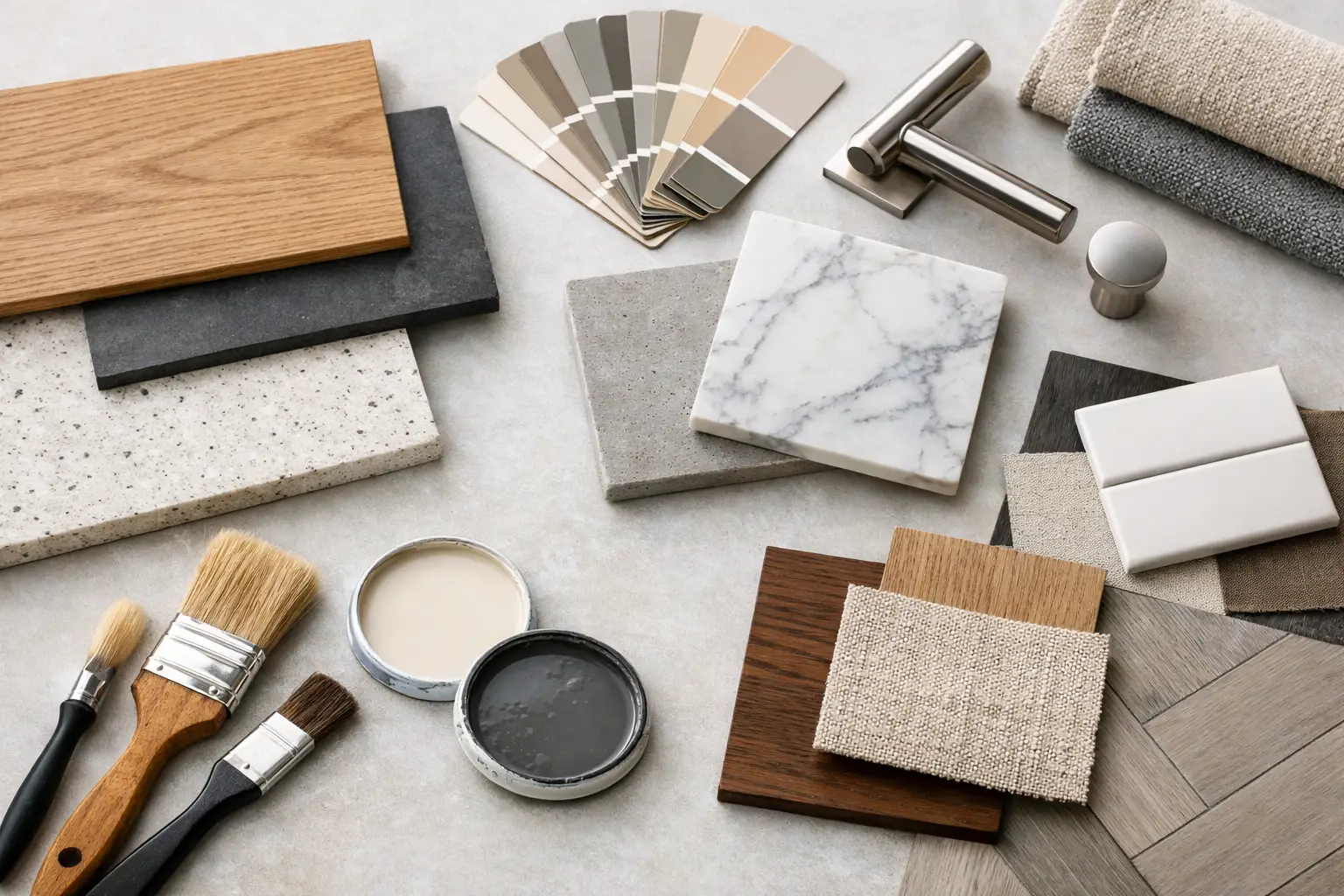
A finish can look perfect on a showroom wall and disappoint the moment it meets a sunny Brooklyn apartment, a busy family kitchen, or a bathroom with poor ventilation. That is why knowing how to choose interior finishes is not about collecting samples you like. It is about choosing materials that work together, hold up to real life, and make sense for the budget and construction schedule.
When clients come into the showroom, we do not begin with random tile, paint, or cabinet colors. We start with the rooms, the existing conditions, how the household lives, and what is staying versus changing. A beautiful finish is only a good choice when it still looks right after installation, daily use, and a few years of wear.
Start With the Space Before the Sample
The same finish behaves differently from one home to another. Natural oak flooring may feel warm and refined in a bright brownstone, but its undertone can turn unexpectedly yellow next to a cool gray stone. A glossy lacquer cabinet can give a compact kitchen a clean, contemporary look, but it will show fingerprints more than a textured matte surface.
Look at natural light first. North-facing rooms tend to pull cooler, while direct southern or western light can bring out warmth and sheen. Then look at the fixed elements: windows, radiators, ceiling height, existing floors, and the condition of the walls. In New York apartments especially, no two spaces are really alike. An old wall that is out of square, a low bulkhead, or an uneven floor can affect what material is practical and how it should be installed.
This is where measurements matter more than inspiration photos. Before selecting a large-format porcelain tile, for example, confirm the floor is level enough to support it. Before committing to full-height cabinetry, confirm the ceiling dimensions in several places, not just one. Small field conditions can change the result dramatically.
Choose Interior Finishes in the Right Order
Clients often fall in love with a decorative pendant, a bold wallpaper, or a particular sofa fabric first. There is nothing wrong with that, but the project still needs an order. Start with the finishes that are most expensive or difficult to change: flooring, cabinetry, countertops, wall tile, plumbing fixtures, and doors.
Once those decisions are settled, move to paint, lighting, furniture upholstery, window treatments, and accessories. This protects the larger investment. It is easier to adjust a paint color than to replace a countertop because the paint no longer works with it.
For a kitchen or bath, we usually want to see the cabinet finish, slab or countertop sample, backsplash option, and hardware together. Looking at each item separately is how clients end up with a room where every material is attractive but nothing relates properly. The goal is contrast with control. If the countertop has strong movement, the cabinet fronts may need to be calmer. If the cabinets are richly textured wood, a quieter stone can give the room room to breathe.
Think About Use, Not Just Appearance
A kitchen has to look impressive, but it also has to work every morning and every dinner. The same applies to every room. Ask direct questions before making material decisions: Who uses this space? Is there a dog? Young children? Do you cook every day? Is this a primary residence, a rental, or a weekend home?
Natural stone is a good example. Marble has character that manufactured surfaces cannot fully copy, but it can etch and stain. For some clients, that living patina is exactly the point. For others, especially in a heavily used kitchen, porcelain or engineered stone may be the smarter choice. Neither answer is universally right.
Wood floors need the same honest conversation. Wide-plank engineered wood can be an excellent option for an apartment because it offers real wood character with greater stability than solid wood. But it can still scratch. A wire-brushed or matte finish will hide normal wear better than a very smooth, dark, high-gloss floor. If the household expects the floor to remain untouched, wood may not be the right expectation. If they want a material that gains character over time, it can be a very good one.
In bathrooms, maintenance and moisture are not secondary details. A polished tile can look beautiful but may be too slippery for a shower floor. Grout color changes the maintenance conversation as well. Bright white grout creates a crisp look, but it requires more attention than a mid-tone grout that is closer to the tile color.
Do Not Judge Materials Under Showroom Lighting Alone
Showroom lighting is useful, but it is not your home. Take samples to the project when possible and view them morning, afternoon, and evening. Put the countertop next to the cabinet door. Place the flooring beside the paint sample. Hold metal hardware against the stone rather than looking at it under a separate light.
Undertones are where many expensive mistakes begin. Two materials can both read as white, but one may lean creamy, one gray, and another slightly pink. The difference may be barely visible alone, then obvious when installed side by side. The same is true with brass, bronze, nickel, black, and stainless finishes. They do not have to match exactly, but they should look intentional together.
Pay attention to texture too. A room with polished stone, glossy cabinetry, mirrored surfaces, and shiny metal can feel cold or overly hard. Add balance with matte finishes, wood grain, textured fabric, or a hand-finished tile. On the other hand, a room made entirely of soft matte finishes may need a little reflection from glass, metal, or a controlled sheen.
Budget for the Whole Finish, Not Just the Material
A sample price is not a project price. The real number includes delivery, fabrication, trim pieces, substrate preparation, labor, sealing where required, hardware, waste allowance, and installation. A tile that appears less expensive per square foot can become costly if the layout requires many cuts or if the room needs extensive floor leveling first.
Custom work also needs clear scope. A bespoke cabinet finish, a bookmatched stone wall, or a custom veneer panel can produce a very different result from an off-the-shelf alternative, but it affects lead times and coordination. Italian cabinetry and furniture can be worth waiting for when the design calls for precise dimensions, quality hardware, and a finish that cannot be substituted. It just needs to be planned early, not added at the end after construction has already started.
Ask what is included and what is not. Is the stone priced as a slab or fabricated and installed? Does the cabinet quote include fillers, panels, lighting, interior accessories, and installation? Are there delivery restrictions for the building? These are not small questions in New York City, where elevators, certificates of insurance, loading windows, and building rules can change both timing and cost.
Respect Lead Times and Installation Sequence
Finishes are connected to the construction schedule. A faucet cannot be selected without considering the sink and countertop configuration. Flooring may need to be installed before cabinetry in one project and after cabinetry in another, depending on the design and material. Wallcovering should not arrive after the painters have already finished the room.
The best projects make decisions early enough to avoid substitutions made under pressure. A substitute is not always a disaster, but it should be a choice, not an emergency. When new stock arrives in the showroom, clients are often excited because they can see and touch something available now. That can be useful, especially when a project has a real deadline, but availability should still fit the overall design instead of driving every decision.
Keep finish schedules organized. For every selected item, record the manufacturer, exact color or finish code, size, quantity, location, lead time, and installer requirements. Photos alone are not enough. “Warm white tile” can mean ten different products, and a cabinet finish may vary from one collection to another.
Make the Whole Home Feel Connected
A home does not need one color repeated in every room. It does need a consistent point of view. You might carry the same oak tone from the living room into a bedroom, then change the wall color and textiles for a different mood. You might repeat a brushed nickel or warm bronze detail in the kitchen, bath, and entry without making every fixture identical.
Transitions deserve attention. Flooring changes at doorways, countertop edges, cabinet reveals, baseboards, and tile terminations are the details people notice once they move in. Good design is not only the larger selection. It is also deciding where one material stops and the next begins.
Bring photographs, measurements, and any samples you already have when you visit a showroom. We can look at the space, put the materials together, discuss what needs to be custom-made, and tell you where spending more will make a visible difference. The right finish is the one that still feels right when the room is finished, the installers are gone, and you are living in it every day.