
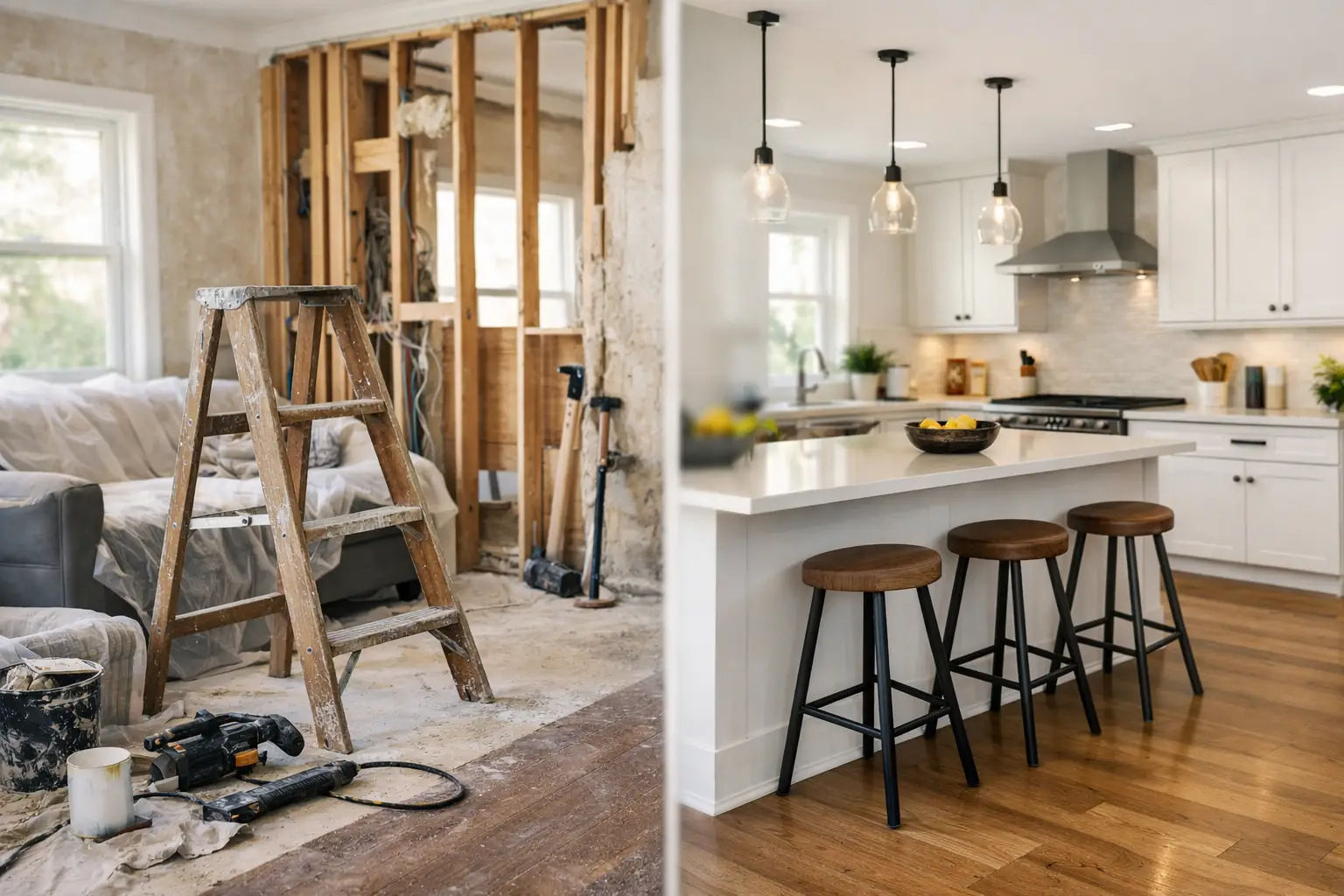
A client walks into the showroom and says, "We want to renovate the apartment." Five minutes later, they are talking about moving walls, reworking the kitchen layout, and adding custom cabinetry. At that point, we are not really talking about a simple refresh. That is why the home renovation vs remodel question matters more than people think.
Most homeowners use the two terms interchangeably, and that is understandable. In real projects, the line can blur. But if you are planning work in Brooklyn, where space is tight, buildings have rules, and every square foot matters, the difference affects your budget, timeline, permits, and the kind of team you need.
Home renovation vs remodel: the real difference
The simplest way to put it is this. A renovation updates what is already there. A remodel changes how the space works.
If you replace old tile, refinish floors, install new lighting, paint walls, or swap dated kitchen fronts for better ones while keeping the basic layout, that is usually a renovation. You are improving condition, appearance, and sometimes performance, but the structure of the space stays mostly intact.
A remodel goes further. If you remove a wall, change the kitchen footprint, relocate plumbing, rebuild a bathroom layout, or turn separate rooms into one open living area, you are remodeling. The space is being reconfigured, not just refreshed.
This is where people get tripped up. A project can start as a renovation and become a remodel once you ask one serious question: should we keep the layout? The moment the answer is no, the project changes.
Why the distinction matters before you ask for pricing
A lot of homeowners want a quick estimate at the beginning. That makes sense. But pricing a renovation is very different from pricing a remodel.
With renovation work, there are usually fewer unknowns. If the footprint stays the same, measurements are clearer, labor is easier to predict, and the schedule is tighter. You may still run into surprises behind walls, especially in older Brooklyn properties, but the scope is more controlled.
With remodeling, uncertainty goes up. Once you move plumbing, alter electrical plans, open walls, or adjust the layout, you add complexity fast. Engineering may come into play. Permits may become more involved. Building management may need approvals. Installation sequencing gets tighter because one trade depends on the next. Budget ranges widen because there are more variables.
That does not mean remodeling is the wrong move. Sometimes it is the only move that makes sense. But it should be discussed honestly from the start.
When renovation is the smarter choice
There are many cases where renovation gives the better return. If the layout already works, there is no reason to break the apartment apart just to say you did a major project.
A well-planned renovation can completely change the feel of a home through materials, finishes, lighting, storage, and custom details. In kitchens, for example, better cabinetry, stronger hardware, improved surfaces, and more thoughtful organization can make the room feel new without relocating every utility line. In bathrooms, upgrading tile, fixtures, vanities, and lighting can deliver a much cleaner, more current result without rebuilding the entire room.
This approach is often right for clients who want quality but also want to keep control over time and cost. It is also practical in buildings where structural work or major plumbing changes are difficult.
A renovation makes sense when the bones are good, the proportions work, and the problem is age, not function.
Good renovation projects usually start with honest restraint
This is where experience matters. Not every home needs dramatic intervention. Sometimes the smartest decision is to leave a good layout alone and invest in the parts you touch every day - cabinetry, surfaces, appliances, fixtures, flooring, and storage.
That is especially true if you care about material quality. Many clients would rather put money into custom millwork, durable finishes, and proper installation than spend the same amount on demolition and reconstruction that does not improve daily life enough.
When a remodel is worth it
A remodel earns its value when the current layout is actively working against you.
Maybe the kitchen is cut off from the living space. Maybe there is not enough storage because the apartment was designed decades ago for a different way of living. Maybe the bathroom is large but inefficient. Maybe you bought a property with good location and poor flow, and you want to make it fit your life now, not the habits of a previous owner.
In those cases, surface updates are not enough. New finishes on a bad layout still leave you with a bad layout.
A remodel is often the better choice when you cook seriously, entertain often, work from home, or need the apartment to function at a higher level every day. If changing the plan solves repeated frustration, the extra investment is easier to justify.
Home renovation vs remodel in kitchens
Kitchens are where this conversation gets real very quickly. Home renovation vs remodel is not abstract here. It comes down to measurements, workflow, appliance placement, storage depth, ventilation, and whether the room supports the way you actually live.
If your kitchen layout is solid but the cabinets are worn out and storage is poorly organized, renovation may be enough. New cabinetry, better interior fittings, improved lighting, and higher-grade materials can transform the space.
If the refrigerator blocks circulation, the island is impossible, the sink is in the wrong place, or the whole room feels cramped because of the plan itself, that is remodel territory. At that point, design is not just about finishes. It is about correcting function.
This is also why serious clients should not separate design from execution too early. A beautiful layout on paper is not enough. It has to be buildable, measured correctly, and aligned with real product dimensions and installation requirements.
Brooklyn homes make the decision more specific
In Brooklyn, the condition of the property changes everything. Brownstones, prewar apartments, co-ops, condos, and newer developments all come with different limitations.
Older homes may hide uneven floors, old piping, outdated wiring, and walls that are not as straightforward as they look. Co-ops may place tighter restrictions on work hours, wet-over-dry rules, and alteration approvals. In some buildings, a renovation is the practical path because a full remodel adds layers of review and delay. In others, it is worth doing the harder work once so the apartment functions properly for the next 15 years.
This is why showroom conversations matter. You can look at beautiful images all day, but until someone studies the floor plan, asks how you use the space, and talks through materials and installation realities, you do not know whether you are planning a renovation or a remodel.
Budget, timeline, and stress level
People usually focus on budget first, but timeline and disruption matter just as much.
A renovation is typically faster and easier to phase. A remodel usually means more demolition, more decisions, and more dependency between trades. That creates more pressure points. If you are living in the home during the work, the difference is not small.
There is also decision fatigue. A renovation still requires choices, but a remodel multiplies them. Layout, appliance specifications, plumbing locations, electrical planning, millwork dimensions, clearances, door swings, and finish coordination all have to be resolved properly. If those decisions are made late, the project slows down and costs move.
That is why the cheapest-looking estimate is often not the most honest one. If the scope is really a remodel, but it is being priced like a renovation, the gap will show up later.
So which one should you choose?
Start with the layout, not the finishes. If the space already works and the issue is age, wear, or lack of character, renovate. If the space looks acceptable but performs poorly every day, remodel.
Then ask a harder question. Where will your money matter more? In many homes, the answer is custom cabinetry, durable materials, better lighting, and skilled installation. In others, no finish upgrade can fix a plan that never worked.
At D&D Design Center, this is usually the point where the conversation gets useful. Not when someone asks for a vague square-foot price, but when they bring measurements, photos, and real priorities. Then you can tell what is worth changing, what should stay, and where the project can be ambitious without becoming wasteful.
If you are unsure, do not start by saying you need a renovation or a remodel. Start by saying what is not working in the home. A good team can tell you which path makes sense. And that answer will save you more than any early guess at a budget.