
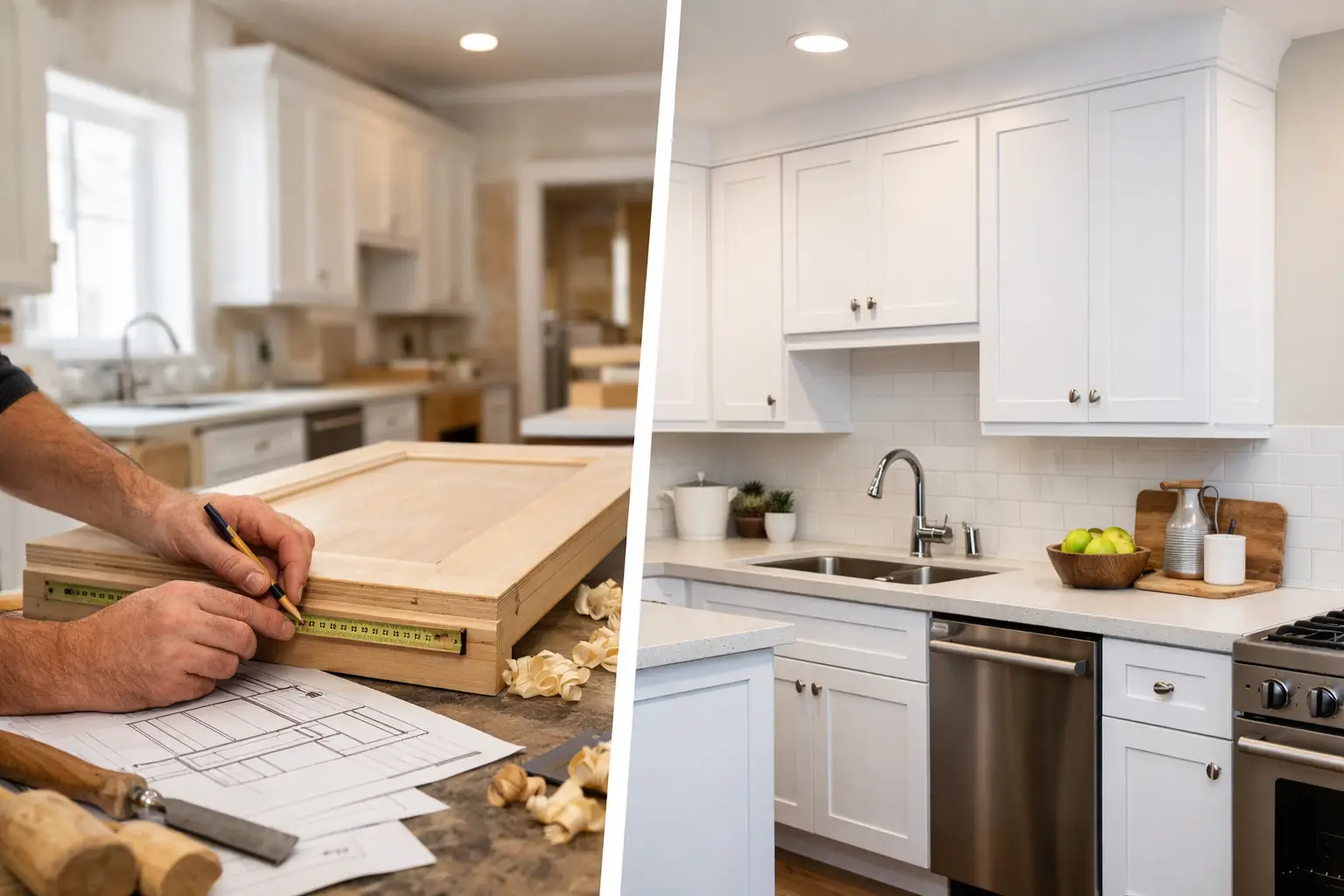
A cabinet decision usually becomes real when the measurements are on the table. Maybe the ceiling is uneven, the kitchen has an awkward corner, or you need storage that works around a radiator, window, or structural column. When clients ask us about custom cabinets vs stock, they are rarely choosing between “good” and “bad.” They are deciding where precision is worth paying for, where speed matters, and what will make sense in their home five or ten years from now.
A beautiful kitchen is not only about the door style. It is about whether the drawers clear the island, whether the pantry holds what you actually buy, whether the finish stands up to daily use, and whether the installation is planned before a problem shows up on site.
Custom Cabinets vs Stock: The Real Difference
Stock cabinets are manufactured in preset sizes, standard finishes, and a limited group of configurations. They are designed to be ordered quickly and installed in common kitchen layouts. If your room is straightforward and the available sizes happen to work, stock cabinetry can be a sensible way to control the budget.
Custom cabinetry is made for the room rather than forced into it. The width, height, depth, interior layout, door construction, finish, and hardware can be specified around your exact plan. That does not mean every project needs custom work from floor to ceiling. It means you are not accepting filler panels, wasted corners, or compromises simply because a catalog does not offer the size you need.
There is also a middle category that creates confusion: semi-custom cabinets. These usually begin with a standard cabinet system but offer more sizes, finishes, and modification options than stock. For some homes, semi-custom is the right balance. For others, especially apartments with difficult walls or clients who want a very specific Italian look, it still does not provide enough control.
When Stock Cabinets Make Sense
Stock cabinets are not automatically a shortcut or a low-quality choice. They can work well in a rental refresh, a resale-focused renovation, a secondary kitchen, or a home where the existing layout is simple and the goal is to move quickly.
The main advantage is predictability at the front end. You can often see a clear price range early, and certain lines are available faster than made-to-order cabinetry. If the kitchen uses standard widths and you are comfortable with a smaller selection of colors and door profiles, that convenience has value.
But the price you see for stock cabinets is not always the final number. Installation, fillers, crown molding, panels, hardware upgrades, delivery, countertop coordination, and modifications can change the picture. In Brooklyn apartments, a cabinet that looks standard on a drawing can become complicated once it has to fit through an elevator, around existing plumbing, or against walls that are not square.
Stock cabinetry also asks you to design around its limitations. A 30-inch base cabinet is a 30-inch base cabinet. If your room needs 31 1/2 inches to make the layout work properly, someone has to solve that gap. Sometimes that solution is harmless. Sometimes it becomes a visible filler strip in the exact place you hoped would look clean and intentional.
What You Gain With Custom Cabinets
Custom cabinets earn their place when the room has challenges, when storage needs are specific, or when the finished result needs to feel integrated with the rest of the home. In a prewar apartment, a townhouse renovation, or a high-end condo, standard sizes often leave too much on the table.
With custom work, we can plan the cabinet depths around circulation, build tall units to use vertical space, and organize interiors around the way you cook. That may mean deep drawers for cookware, a properly sized pantry, concealed appliance storage, or cabinetry that continues into a dining area without looking like an afterthought.
Material choice is another major difference. Stock lines may offer attractive finishes, but custom cabinetry gives you greater control over veneer selection, lacquer color, wood grain direction, edge details, interior finishes, and hardware. Those are not decorative details when you use the kitchen every day. They affect how the cabinets wear, clean, open, and age.
For clients looking at Italian kitchen cabinets, the advantage is often proportion as much as appearance. Italian systems are known for clean lines, precise construction, and a more furniture-like approach to cabinetry. The goal is not to make the kitchen look expensive for one photograph. It is to make the composition feel right from every angle, including when the cabinets are open and the room is in use.
Custom work also makes sense outside the kitchen. A media wall, entry storage, closet system, home office, or bathroom vanity often benefits from exact dimensions more than a standard kitchen does. If a room is tight, every inch matters.
Cost: Look Beyond the Initial Cabinet Price
Clients often expect stock cabinets to cost less and custom cabinets to cost more. In general, that is true. Custom cabinetry involves design time, detailed drawings, made-to-order production, specialized materials, and more careful installation. It is not the right choice for every budget.
Still, the better question is not, “What is cheaper?” It is, “What am I paying for, and what compromises am I accepting?” A stock kitchen may have a lower cabinet price but require more fillers, more site adjustments, and a layout that wastes usable space. A custom kitchen may cost more initially but deliver better storage, a cleaner fit, and finishes that do not need to be replaced quickly.
Budget should be discussed with the full project in view. Cabinets need to work with appliances, countertops, lighting, flooring, plumbing, electrical work, and labor. If you spend heavily on cabinetry but leave no room for proper installation or a countertop you actually like, the plan is not balanced.
At D&D Design Center, we prefer direct conversations about this early. Bring measurements, inspiration images, or a floor plan to the showroom. We can look at the space and tell you where custom work will make a visible difference and where a standard solution may be perfectly reasonable.
Timelines and Installation Are Part of the Decision
Stock cabinets can be faster, but “in stock” does not always mean ready to install next week. Delivery windows, missing pieces, damage claims, and coordinating the rest of the renovation can still affect the schedule. Always confirm what is physically available, not just what appears available in a catalog.
Custom cabinetry takes longer because it is produced after the design is finalized. That timeline can be worthwhile, but only when the measurements are correct and the project is coordinated. We do not want cabinets arriving before floors are ready, appliances are confirmed, or plumbing locations are settled.
Installation is where the difference becomes visible. A good installer can make a strong cabinet line look better, and a careless installation can ruin an excellent one. Walls need to be checked, cabinet runs need to be leveled, door reveals need to be adjusted, and panels need to meet cleanly. This is especially important with frameless European cabinetry, where the lines are minimal and mistakes have nowhere to hide.
How to Choose Without Regretting It
Start with the room, not a cabinet sample. Measure the space carefully, identify the non-negotiables, and be honest about how you live. Do you cook often? Do you need a serious pantry? Are you renovating for yourself or preparing to sell? Is this a compact Brooklyn kitchen where storage needs to work harder, or a larger home where cabinetry must connect visually with adjacent rooms?
Then decide where precision matters. If the layout is simple, the budget is firm, and speed is the priority, a quality stock or semi-custom line may be the right move. If the room is irregular, the design is highly specific, or you want cabinetry that fits like built-in furniture, custom is usually worth serious consideration.
Do not choose based only on a door sample or a social media photo. Ask about cabinet construction, interior materials, hardware, warranty coverage, lead time, delivery, and who is responsible for installation. The answers tell you far more than a showroom display alone.
The right cabinetry should make the room easier to live in, not simply easier to order. Come in with the real dimensions and the real questions. Once we can see the space clearly, the decision usually becomes much less complicated.