
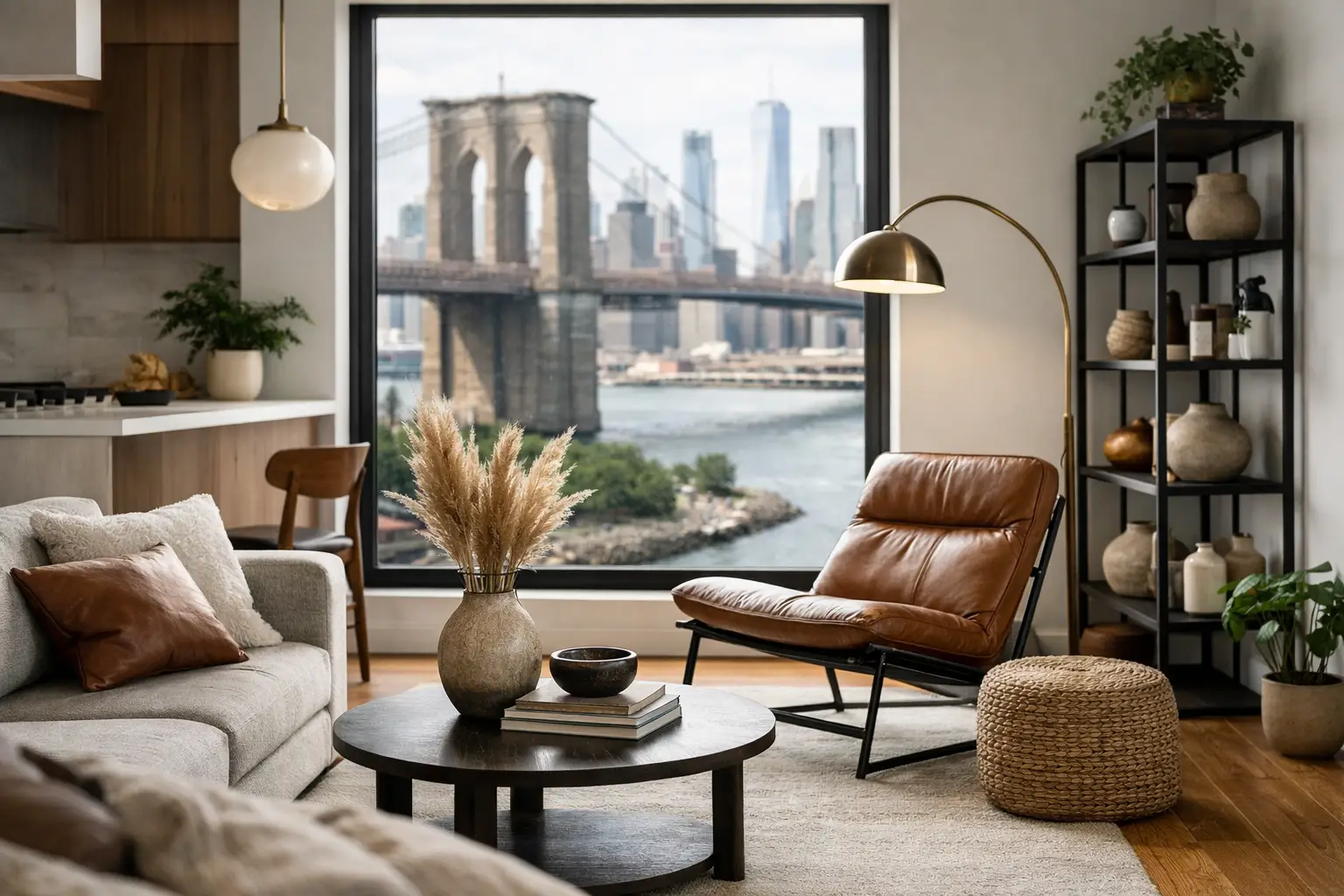
Walk through enough Brooklyn apartments and townhouses and you start seeing the same problem. People want a home that feels current, but they do not want it to look dated in two years. That is really what Brooklyn interior design trends come down to right now - not chasing novelty, but choosing materials, layouts, and details that feel fresh and still make sense once real life starts happening in the space.
In the showroom, that usually means the conversation gets practical very quickly. Clients are not asking for trend boards full of ideas they saw once online. They want to know what cabinet finish will still look clean after heavy use, whether an open shelf wall will become a maintenance problem, and if a soft, warm palette will work in a north-facing apartment that does not get enough light. Those are the right questions.
Brooklyn interior design trends are getting warmer
For a long stretch, Brooklyn interiors leaned very hard into cool minimalism. A lot of white, a lot of gray, black accents everywhere, and spaces that photographed well but could feel cold once you lived in them. That is changing.
The strongest shift now is toward warmth. Not heavy, dark rooms from another era, but warmer woods, creamy stones, textured finishes, and colors with some depth to them. Think soft taupe, clay, mushroom, sand, walnut, smoked oak, brushed bronze. Even when the overall design is modern, the room feels more settled and less stark.
This works especially well in Brooklyn because many homes here need softness. A brownstone with original detail can handle richer tones and natural wood without losing character. A newer condo often needs those same materials to avoid feeling flat and overbuilt. Warmth brings balance to both.
There is a trade-off, though. Warm palettes only work when the materials are chosen carefully. If everything turns beige without contrast, the room loses structure. We usually advise clients to mix one or two grounding elements into the space - darker cabinetry, a sharper stone pattern, metal detailing, or more defined millwork - so the room still has shape.
Kitchens are cleaner, but not empty
The kitchen remains the center of most projects, and Brooklyn clients have become much more precise about what they want from it. They still like a clean look, but they are less interested in sterile minimalism. The trend now is hidden function.
That means integrated storage, better pantry planning, appliance placement that does not interrupt the room, and cabinetry designed around daily use instead of just symmetry. A kitchen has to look impressive, but it also has to work every morning, every dinner, every rushed weekday.
We are also seeing stronger interest in European and Italian-style kitchen systems because they handle this balance well. The lines are clean, but the engineering behind them is serious. Drawers are planned better. Interior fittings make sense. Finishes tend to be more refined. For Brooklyn apartments where every inch matters, that difference is not cosmetic.
Large islands are still popular, but not in every space. In many Brooklyn homes, an oversized island can hurt circulation more than it helps. A better solution is often a more proportional island with strong storage, or a peninsula that gives you prep space without forcing the room to work around it. Good design is not about squeezing in every feature. It is about making the room function correctly.
Statement stone is being used more carefully
Natural stone is still a major part of what people want, especially in kitchens and baths, but the approach is more disciplined now. Instead of using a loud slab everywhere, clients are choosing one surface to carry the room. That might be a waterfall island, a full-height backsplash, or a vanity wall in a powder room.
The reason is simple. Stone has presence. If you use it in too many places, the effect disappears. If you use it in the right place, it becomes the thing that gives the room weight and identity.
Custom storage matters more than decoration
One of the clearest Brooklyn interior design trends is that built-in storage is no longer treated as a secondary item. In many homes, it is one of the first things that should be discussed.
Brooklyn clients are often dealing with real space limitations. Even in larger homes, they want cleaner sight lines and less visual clutter. That means mudroom-style entry storage, wall units that actually fit the room, bedroom wardrobes designed to the ceiling, and media cabinetry that hides what should be hidden.
This is where custom work earns its value. Ready-made pieces can help in some situations, but they rarely solve the full problem. If the ceiling is uneven, if the walls are not square, if you need storage around radiators, windows, or awkward corners, custom millwork is what makes the room feel finished instead of compromised.
And custom does not have to mean ornate. In Brooklyn right now, the better custom storage is quieter. Flat-panel millwork, refined reveals, integrated lighting, cleaner hardware choices, and finishes that connect to the rest of the home instead of calling attention to themselves.
Vintage influence is back, but in a controlled way
Clients still want modern interiors, but fewer want a home that looks like it was assembled from one catalog. There is more interest now in mixing periods and letting a room feel collected.
That might mean a contemporary kitchen paired with older-style dining chairs, a sleek bedroom with a burl wood nightstand, or a modern living room with one vintage light fixture that changes the tone of the whole space. In Brooklyn, this layered approach makes sense. The architecture often has history, and the interiors look better when they acknowledge that.
Still, there is a line. If every room tries to make a statement, the home starts feeling busy. Usually one or two vintage or character-driven pieces per room is enough. The rest should support them.
Texture is replacing obvious pattern
Another shift worth noticing is that texture is doing more of the work that pattern used to do. Clients are less interested in rooms full of graphic prints and high-contrast surfaces. They want depth, but they want it in a quieter way.
That shows up in ribbed wood panels, limewash walls, bouclé and wool upholstery, fluted glass, brushed metals, and natural stone with movement. These materials give the room richness without making it feel crowded.
This is also a smart direction for Brooklyn homes where open layouts are common. When one room flows into another, too much pattern can make the whole apartment feel fragmented. Texture keeps things interesting without breaking continuity.
Bathrooms are becoming more architectural
Bathrooms are no longer being treated as simple utility spaces with upgraded tile. Clients want them to feel composed. That means stronger vanity design, better lighting, cleaner shower detailing, and materials that relate to the rest of the home.
Floating vanities are still in demand, but only when they fit the scale of the room. In some Brooklyn bathrooms, especially older ones with modest square footage, a floating vanity can make the room feel better proportioned. In others, a more grounded custom vanity with serious storage is the better choice. Again, it depends on how the space is actually used.
We are also seeing more interest in slab or large-format applications because they reduce visual clutter. Less grout, fewer interruptions, stronger surfaces. The room looks calmer and maintenance is easier.
Practical luxury is winning
This may be the biggest shift behind all the others. Brooklyn clients still want beauty, but they are less interested in luxury that only works in photos. They want materials that age well, upholstery that can handle real use, cabinetry hardware that feels substantial, and layouts that support daily routines.
That is why performance fabrics, matte finishes, durable engineered surfaces, better drawer systems, and quality lighting plans matter more than trendy accessories. A room feels expensive when the proportions are right, the materials are honest, and nothing feels accidental.
It also means budgets are being spent differently. More clients are willing to invest in millwork, kitchens, stone, and installation, then keep the decorative layer more restrained. That is usually the right move. You notice construction quality long after small styling details stop feeling new.
For homeowners planning a remodel, the smartest approach is to use trends as a filter, not a blueprint. If a finish looks good but does not fit the light in your apartment, skip it. If an island trend compromises movement in the kitchen, do not force it. If a warm palette helps the home feel better, build from there with materials that can take use and still look right.
Good interiors in Brooklyn are getting less performative and more considered. That is a good direction. When you walk into a well-designed home, you should feel that someone thought through the measurements, the storage, the stone, the lighting, and how the space will actually live. Bring that conversation into the showroom with real dimensions and real priorities, and the right design decisions usually become very clear.