
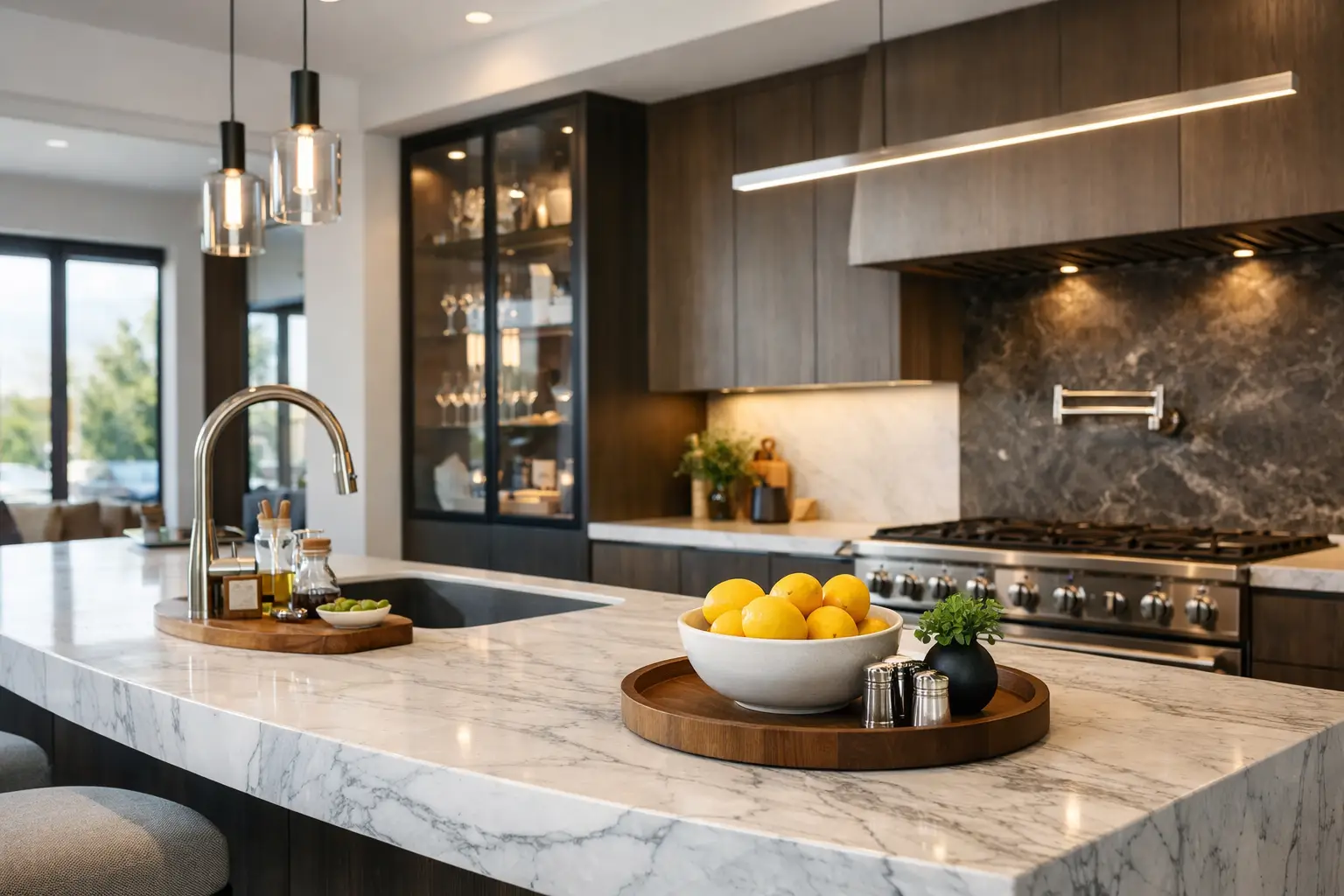
A luxury kitchen should not feel like a display that nobody is allowed to touch. The strongest 2026 luxury kitchen trends are moving in the other direction: warmer materials, better storage, quieter technology, and details that make daily use easier without making the room look overly engineered. That is what clients are asking about when they come into the showroom with floor plans, renovation questions, and a clear idea that they do not want another all-white kitchen.
The good news is that this is not about chasing a color of the year. It is about making decisions that will still feel right after the construction dust is gone and the kitchen has handled two years of breakfasts, dinners, guests, and real family life.
2026 Luxury Kitchen Trends: Warmth With Discipline
For years, the default luxury kitchen was white lacquer, pale quartz, and a large waterfall island. That look still has a place, especially in apartments with limited natural light. But the shift for 2026 is toward rooms with more depth. Think smoked oak, walnut, sand-toned lacquer, soft clay finishes, brushed metal, and natural stone with movement rather than a perfectly uniform surface.
Warm does not mean dark. In a Brooklyn brownstone, a walnut kitchen may look exactly right. In a smaller New York apartment, the same wood can become too heavy if it covers every wall. This is where proportion matters. We may use wood for the tall cabinetry, a lighter matte finish for the base cabinets, and stone to keep the whole composition open.
The material combination needs to be intentional. A kitchen with too many finishes can look expensive on paper and confused once installed. Usually, two cabinet finishes, one primary stone, and one metal finish are enough to create a serious result.
Real wood and wood-look finishes both have a role
Clients often ask if a luxury kitchen must use real veneer. Not always. High-quality textured laminates and engineered finishes have improved significantly, and they can be the smarter choice for a high-use family kitchen or a rental investment. They are consistent, durable, and easier to replace if a panel is damaged.
Natural veneer has character that manufactured surfaces cannot fully copy. It also asks for more care and better coordination during fabrication and installation. The right answer depends on the budget, sunlight, how the kitchen will be used, and whether the client wants every door to have its own natural variation.
Storage Is Becoming More Tailored
The most valuable luxury feature is often the one nobody sees from across the room. It is the pantry that keeps small appliances off the counter, the deep drawer organized around actual cookware, or the tall cabinet that holds trays without forcing you to pull everything out first.
In 2026, clients are less interested in adding cabinets just to fill a wall. They want cabinetry planned around their habits. If you cook often, drawer depth, internal dividers, spice storage, and access near the cooking zone matter more than another decorative glass door. If you entertain, a beverage area or concealed coffee station may be worth more than an oversized island.
This is why measurements have to happen before a kitchen is selected. We ask what stays on the counter, how many people cook at one time, whether there is a separate pantry, and which appliances are non-negotiable. A beautiful cabinet layout can fail quickly if the refrigerator door blocks a passage or the dishwasher opens into the only working aisle.
The hidden kitchen is becoming more practical
Pocket doors, retractable panels, and appliance garages remain popular, but they need to be used carefully. Hiding the coffee machine and toaster can make the kitchen feel calmer. Hiding every working function can become frustrating if the doors are heavy, the interior has poor lighting, or the client has to open several panels just to make coffee.
Use concealment where it improves the room. A breakfast station near the dining area is a good candidate. The main cooking zone, where speed and access matter, may be better left direct and open.
Stone Should Be Chosen for Daily Life
Natural stone continues to lead the conversation, especially honed marble, quartzite, travertine, and richly veined granite. There is more interest now in stone with personality: warm veining, mineral depth, and less predictable patterns. A slab should not look like printed wallpaper.
But this is also the point where a designer needs to be direct. Marble is beautiful, and it can etch. That is not a defect. It is part of the material. For some clients, the soft marks that develop over time are exactly what they want. For others, especially families who want zero anxiety around lemon juice, red wine, and busy weekends, quartzite or a premium engineered surface may make more sense.
The current preference for a full-height backsplash or stone return behind open shelving can be striking. It also affects budget. Fabrication, slab yield, seams, outlet placement, and installation complexity all need to be discussed early. The same is true for waterfall islands. They are not automatically a luxury upgrade. On the right slab and in the right room, they look clean and architectural. In a tight layout, they can spend money where better storage or appliances would have made a bigger difference.
Appliances Are Quieter and Less Visible
Luxury appliance planning in 2026 is less about showing off a wall of stainless steel and more about reducing visual noise. Integrated refrigeration, concealed dishwashers, induction cooking, and ventilation designed into the architecture are becoming standard requests in high-end projects.
Induction deserves serious consideration. It is fast, precise, easier to clean, and keeps the surrounding area cooler than gas. The trade-off is that some clients still prefer cooking with flame, and an induction installation may require electrical upgrades. In older buildings, that needs to be checked before anyone falls in love with a specific cooktop.
Ventilation is another detail that should never be treated as an afterthought. A beautiful hood is useless if the ducting is undersized or poorly routed. A concealed hood can work well, but it must be matched to the cooking style and the room. If someone cooks heavily every day, performance comes before minimalism.
Islands Are Being Designed as Furniture
The kitchen island is getting softer in 2026. Instead of a large cabinet box dropped into the center of the room, more projects use furniture-like legs, curved ends, open display sections, or a contrasting finish that separates the island from the perimeter cabinetry.
That does not mean every kitchen needs a curve. Curved cabinetry costs more, requires precise fabrication, and can reduce usable storage. It earns its place when it improves circulation or gives a wide open room a more finished look. In a narrow kitchen, a clean rectangular island with proper clearances is usually the better decision.
What matters is that the island has a job. It may be a prep surface, a seating area, a serving station, or storage for everyday items. Trying to make it all four can create a piece that is too large and too crowded.
Lighting Is More Layered, Less Decorative
A single dramatic pendant is no longer enough. Luxury kitchens are being planned with layers: recessed lighting for general brightness, under-cabinet lighting for work, interior cabinet lighting where it adds value, and a decorative fixture only where it has room to breathe.
Good lighting makes cabinetry and stone look better, but it also makes the kitchen more usable at night. We pay attention to color temperature, glare on polished surfaces, and where shadows fall at the counter. Warm light usually works best with wood and natural stone, while overly cool lighting can make even excellent materials feel sterile.
The same thinking applies to hardware. Large, sculptural pulls are not disappearing, but integrated channels and discreet edge pulls are gaining ground. They keep the cabinetry clean, especially with Italian kitchen cabinets that already have strong proportions and precise door details. Hardware should feel good in the hand and hold up to constant use. That matters more than whether it photographs well for one day.
Plan the Kitchen Before You Fall for the Finish
The best 2026 luxury kitchen trends are useful because they support a better project, not because they create a faster design decision. Start with the space, the building conditions, the appliance requirements, and the budget range. Then choose the finishes that fit the plan.
At D&D Design Center, the conversations that go smoothly are the ones where clients bring measurements, inspiration, and honest questions about timing. Custom Italian cabinetry, specialty stone, and coordinated installation require planning. Some pieces are worth waiting for. Others can be selected from available collections to protect the schedule without lowering the quality of the result.
Bring the plans into the showroom before committing to a cabinet color or an island shape. We can talk through what will work in the actual room, what needs to be custom-made, and where it makes sense to spend. A kitchen has to look impressive, but it also has to work every morning, every dinner.